Demantoid
Andradite · Ca₃Fe₂(SiO₄)₃. Colors: yellowish green to green.
- Mohs
- 6.5
- RI
- 1.88–1.889
- SG
- 3.8–3.88
- Crystal system
- cubic
Demantoid at a glance.
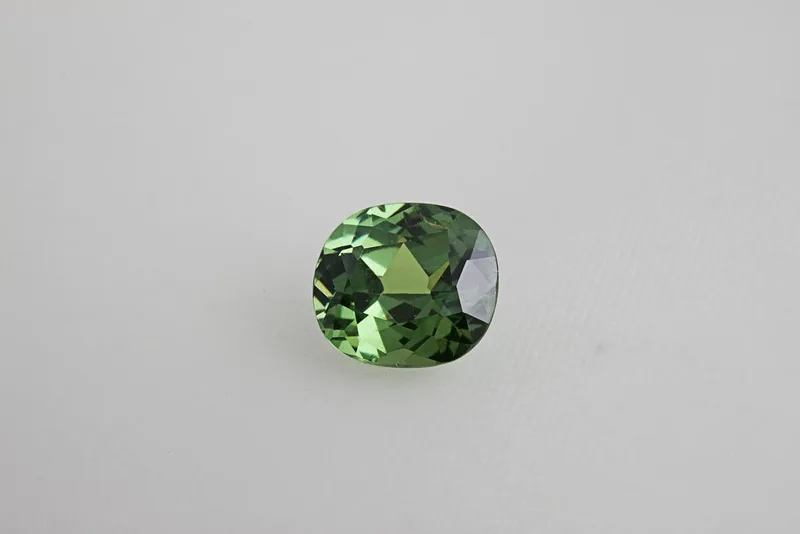
- Species
- Andradite
- Formula
- Ca₃Fe₂(SiO₄)₃
- Crystal system
- cubic
- Mohs
- 6.5
- RI
- 1.88–1.889
- SG
- 3.8–3.88
- Colors
- yellowish green to green
What the encyclopedia says.
4 passages, quoted as published. Each links to the full entry and the sources of its chapter.
Species, varieties and groups
Above species sits the group, a family of species that share a structure but differ in chemistry. Garnet and tourmaline are groups, which is why “garnet” covers stones as different as red pyrope and green demantoid.
Read the full entryThe garnet group
Grossular, Ca₃Al₂(SiO₄)₃, occurs in nearly every color except blue and reads 1.731–1.760 with a specific gravity of 3.40–3.78. Its green variety tsavorite is narrower, 1.739–1.744 and 3.57–3.65, and is colored mainly by vanadium with some chromium. Hessonite is orange to cinnamon brown grossular. Andradite, Ca₃Fe₂(SiO₄)₃, yields demantoid, a chromium-green garnet reading 1.880–1.889 with a specific gravity of 3.80–3.88 and a dispersion of 0.057, higher than diamond's 0.044. Its radiating horsetail inclusions are fibers of serpentine growing from a tiny chromite crystal.
Read the full entryInclusions as fingerprints
Some inclusions point toward a locality. Emeralds from Colombia often contain three-phase inclusions: a jagged cavity holding salty liquid, a carbon dioxide gas bubble and a cube-shaped crystal, probably a halide, trapped from the hot brines that deposited them. They are no longer diagnostic of Colombian origin, since the same inclusions have since been found in emeralds from several other deposits. Demantoid garnets, notably from Russia’s Urals, may contain horsetails: curving sprays of chrysotile fibers radiating from a minute chromite crystal. GIA counts them among the few internal features that raise a gem’s value.
Read the full entryRefractometer, polariscope and dichroscope
The refractometer measures refractive index (RI) by critical angle. A flat facet rests on a dense glass hemicylinder, joined by a drop of contact liquid; the boundary between light and dark on the internal scale marks the stone's RI, read under yellow light. A doubly refractive stone gives two readings as it is turned; their difference is the birefringence, and the way they move shows whether the stone is uniaxial or biaxial. Curved cabochons give a blurred spot reading instead. GIA's contact liquid has an RI of 1.81, and nothing above it can be read, so demantoid, high zircon, cubic zirconia, diamond and garnet at the top of its range show no edge and are recorded as over the limit.
Read the full entry
What a stone like this sells for
Enter what a laboratory report says about a stone like this one and see what similar stones have sold for, or a plain answer that there is not enough data. Free, and in beta.
Buy or sell with a laboratory report
On the Erebaur market every buyer and seller is verified, every stone has a report from an independent laboratory and every payment goes into escrow.