- Mohs
- 8
- RI
- 1.718
- SG
- 3.6
- Crystal system
- cubic
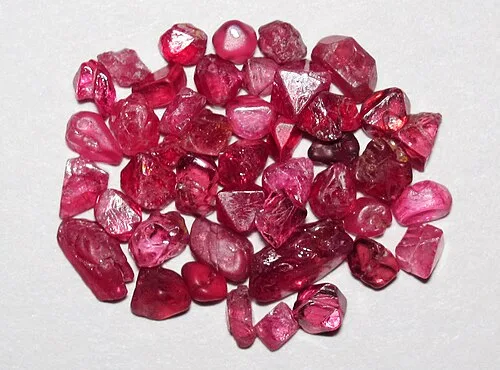
Red spinel at a glance.
- Species
- Spinel
- Formula
- MgAl₂O₄
- Crystal system
- cubic
- Mohs
- 8
- RI
- 1.718
- SG
- 3.6
- Colors
- red to pink (chromium)
What the encyclopedia says.
8 passages, quoted as published. Each links to the full entry and the sources of its chapter.
Reading a property table
Every reference table in this encyclopedia, and every laboratory report, describes a stone with the same short list of measurements. Crystal system is the symmetry of the atomic lattice. Crystallography recognises seven systems, from cubic (diamond, spinel, garnet) to trigonal (corundum, quartz), and the system decides how a crystal grows and how it behaves in polarised light. Mohs hardness is a scratch order, not a scale of equal steps. Refractive index records how much the stone slows and bends light; gemologists read it on a refractometer, and it is the single most useful identification figure for a cut stone. Specific gravity is the ratio of the stone's density to the density of water, so an SG of 3.52 means the stone weighs 3.52 times what the same volume of water weighs. Gemologists weigh a stone in air and again suspended in water to work it out.
Read the full entrySpinel
Spinel is magnesium aluminum oxide, MgAl₂O₄, with a cubic structure, a hardness of 8, a refractive index of 1.718 and a specific gravity of 3.60. Because cubic crystals are singly refractive, spinel shows the same color in every direction, unlike ruby and sapphire, which can look different along different crystal axes. It runs from orange through red, pink and every shade of purple, blue and violet to bluish green.
Read the full entrySpinel
For centuries red spinel was not distinguished from ruby, and many of the famous historical "rubies" are spinels. Two of the best-known in the British crown jewels, the Black Prince's Ruby and the Timur Ruby, are red spinel. The mineralogist Jean Baptiste Louis Rome de Lisle separated spinel from ruby as a distinct mineral.
Read the full entryMetamorphic deposits: marble-hosted rubies
GIA’s review of corundum deposits puts ruby growth in these marbles at roughly 620–670 °C and 2.6–3.3 kbar. The crystals sit scattered through the rock with phlogopite, muscovite, scapolite, margarite, spinel, titanite, pyrite and graphite, which is why fine red spinel comes out of the same workings, Mogok above all. The Mogok Stone Tract in Myanmar has produced pigeon’s blood rubies since about 600 CE.
Read the full entryOrigin reports and their scientific limits
An origin report gives a laboratory's opinion on where a stone was most likely mined. GIA offers it for ruby, sapphire, emerald, Paraíba tourmaline, red spinel and alexandrite, and says it cannot reach a determination in every case. The evidence comes from three directions. Inclusions, the crystals, fluids and growth features trapped inside, reflect the rock the stone grew in. Trace-element chemistry, measured by laser ablation inductively coupled plasma mass spectrometry (LA-ICP-MS), gives a chemical signature. Spectroscopy adds absorption and luminescence data. Each result is compared with reference collections gathered as close to the mine as possible.
Read the full entrySapphire, emerald and spinel records
Bonhams sold the 50.13 ct Hope Spinel, a rose-pink stone from the Kuh-i-Lal mines in Tajikistan, in London on 24 September 2015 for £962,500, about US$30,000 per carat. Bonhams reported this as a record per carat for a faceted spinel, against US$16,000 per carat set in 2013.
Read the full entry“Rubies” that are spinel
Before gemologists could measure a stone’s optical properties, red gems of similar color went into one category. Several of the most famous historic “rubies” are spinel, a magnesium aluminum oxide, while ruby is red corundum, an aluminum oxide. Older European inventories called red spinel balas ruby.
Read the full entry“Rubies” that are spinel
Russia’s Great Imperial Crown, made for Catherine II’s coronation in 1762 by Georg Friedrich Eckart and Jérémie Pauzié, carries 4,936 diamonds and is topped by a spinel of 398.72 ct. The Kiani Crown in Tehran is set with a spinel associated with Aurangzeb. The Timur Ruby, a larger inscribed spinel, is catalogued by the Royal Collection under the object rather than the stone: RCIN 100017, The Timur Ruby necklace. Its usual weight of 352.5 ct comes from published accounts, not from that record, which could not be read here.
Read the full entry
Where it is mined.
Localities from the mine map in Chapter 05.
| Locality | Country | Status | Note |
|---|---|---|---|
| Mogok | Myanmar | artisanal | The classic ruby district; held by TNLA rebels from July 2024 to October 2025 |
| Ratnapura | Sri Lanka | artisanal | Gem gravels worked from hand-dug pits 10–50 m deep |
| Luc Yen | Vietnam | artisanal | Yen Bai province; gems found in placers in 1987 and mined from 1988, now worked by small groups of local miners |
| Mahenge (Epanko) | Tanzania | artisanal | Pinkish red spinel crystals up to 54 kg found at Epanko in August 2007, a few kilometers southwest of Mahenge town |
Cleaning and wear.
From the care table in Chapter 22.
| Stone | Ultrasonic | Steam | Notes |
|---|---|---|---|
| Spinel | Caution | Caution | Usually safe, but fractures can be a problem; rare fracture-filled stones need soapy water or a damp cloth. |
Print the care chart for all 25 stones A4 · PDF · 133 kBUS Letter · PDF · 132 kB
Stones with a name.
| Name | Type | Carats | Origin | Where now |
|---|---|---|---|---|
| Black Prince’s Ruby | Red spinel, uncut | – | Not documented | Imperial State Crown, Tower of London |
| Timur Ruby | Red spinel, inscribed | – | Not documented | Royal Collection; catalogued within RCIN 100017, The Timur Ruby necklace |
| Great Imperial Crown spinel | Red spinel | 398.72 | Not documented | Great Imperial Crown, Diamond Fund, Moscow Kremlin |
Records at auction.
| Stone | Carats | US$ million | House | Date |
|---|---|---|---|---|
| Hope SpinelSpinel, rose-pink, Tajikistan, 19th-century brooch | 50.13 | 1.5 | Bonhams, London | 2015-09 |
What a stone like this sells for
Enter what a laboratory report says about a stone like this one and see what similar stones have sold for, or a plain answer that there is not enough data. Free, and in beta.
Buy or sell with a laboratory report
On the Erebaur market every buyer and seller is verified, every stone has a report from an independent laboratory and every payment goes into escrow.