Alexandrite
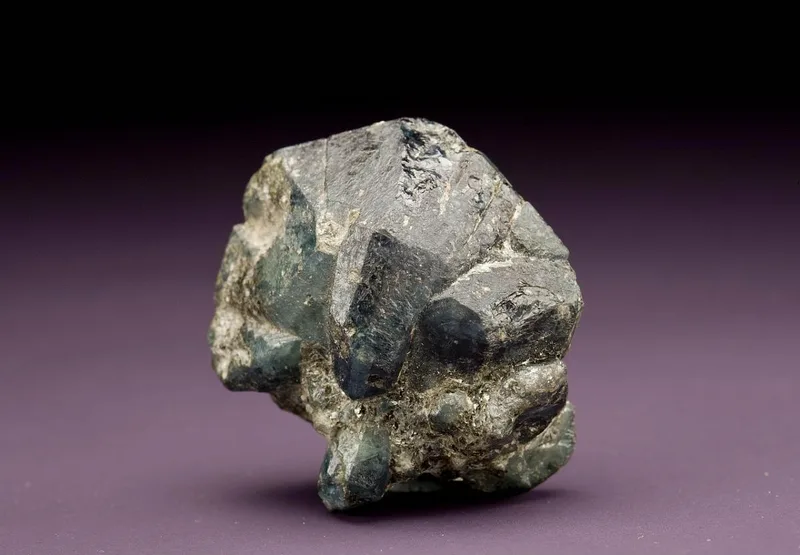
Chrysoberyl · BeAl₂O₄. Colors: bluish green in daylight, purplish red in incandescent light.
- Mohs
- 8.5
- RI
- 1.746–1.755
- SG
- 3.73
- Crystal system
- orthorhombic
Alexandrite at a glance.
- Species
- Chrysoberyl
- Formula
- BeAl₂O₄
- Crystal system
- orthorhombic
- Mohs
- 8.5
- RI
- 1.746–1.755
- SG
- 3.73
- Colors
- bluish green in daylight, purplish red in incandescent light
What the encyclopedia says.
6 passages, quoted as published. Each links to the full entry and the sources of its chapter.
Chrysoberyl: alexandrite and cat’s-eye
Alexandrite is the color-change variety: bluish green in daylight, purplish red under incandescent light. GIA gives it a refractive index of 1.746–1.755 and a specific gravity of 3.73. The change does not come from pleochroism, although alexandrite is strongly pleochroic, but from the way the mineral absorbs light, so the balance tips one way under daylight and the other under lamplight. The variety was first found in Russia's Ural Mountains in the 1830s and named for the future Tsar Alexander II, who freed Russia's serfs and was assassinated in 1881. Sri Lanka, East Africa and Brazil are now its main sources.
Read the full entryThe garnet group
Color-change garnets shift hue between daylight and incandescent light, as alexandrite does.
Read the full entryLabradorescence, aventurescence, color change, iridescence
Color change is a shift in apparent hue between daylight and incandescent light. Alexandrite has an absorption band near 580 nm and transmits both green and red, so it reads green to bluish green in daylight and red to purplish red under a lamp. Some sapphires, garnets and spinels show weaker versions of the effect, and vanadium can produce it in corundum.
Read the full entryOrigin reports and their scientific limits
An origin report gives a laboratory's opinion on where a stone was most likely mined. GIA offers it for ruby, sapphire, emerald, Paraíba tourmaline, red spinel and alexandrite, and says it cannot reach a determination in every case. The evidence comes from three directions. Inclusions, the crystals, fluids and growth features trapped inside, reflect the rock the stone grew in. Trace-element chemistry, measured by laser ablation inductively coupled plasma mass spectrometry (LA-ICP-MS), gives a chemical signature. Spectroscopy adds absorption and luminescence data. Each result is compared with reference collections gathered as close to the mine as possible.
Read the full entryColored stone synthesis
Czochralski pulling, developed by Jan Czochralski in 1918, draws a crystal upward from a melt on a rotating seed and yields large clean boules of synthetic sapphire, alexandrite and yttrium aluminum garnet (YAG).
Read the full entryBirthstones, zodiac stones and anniversary stones
Zodiac stones have no agreed standard: jewelers, astrologers and publishers assign different gems to the same sign. Anniversary gems are conventions too. English-language lists commonly pair ruby with the 40th wedding anniversary, sapphire with the 45th, alexandrite with the 55th and diamond with the 60th, the association behind the term diamond jubilee, which Queen Victoria marked in 1897 after 60 years on the throne. GIA, whose list nicknames the 55th stone emerald by day, ruby by night, says there is no single authoritative source on the subject.
Read the full entry
Where it is mined.
Localities from the mine map in Chapter 05.
| Locality | Country | Status | Note |
|---|---|---|---|
| Malysheva (Mariinsky mine) | Russia | active | Mine in the Ural emerald belt at Malyshevo; emerald and alexandrite come from the same schists, worked since the 1830s |
Cleaning and wear.
From the care table in Chapter 22.
| Stone | Ultrasonic | Steam | Notes |
|---|---|---|---|
| Alexandrite | Safe | Safe | GIA rates both usually safe; use only warm soapy water if fractures have been filled. |
Print the care chart for all 25 stones A4 · PDF · 133 kBUS Letter · PDF · 132 kB
What a stone like this sells for
Enter what a laboratory report says about a stone like this one and see what similar stones have sold for, or a plain answer that there is not enough data. Free, and in beta.
Buy or sell with a laboratory report
On the Erebaur market every buyer and seller is verified, every stone has a report from an independent laboratory and every payment goes into escrow.