Amethyst
Quartz · SiO₂. Colors: light lilac to deep purple, often zoned.
- Mohs
- 7
- RI
- 1.544–1.553
- SG
- 2.64–2.69
- Crystal system
- trigonal
Amethyst at a glance.
- Species
- Quartz
- Formula
- SiO₂
- Crystal system
- trigonal
- Mohs
- 7
- RI
- 1.544–1.553
- SG
- 2.64–2.69
- Colors
- light lilac to deep purple, often zoned
What the encyclopedia says.
7 passages, quoted as published. Each links to the full entry and the sources of its chapter.
Precious and semi-precious
The labels have aged badly. GIA records that amethyst was as expensive as ruby and emerald until the 19th century, when Brazil’s large deposits were found. A fine green tsavorite garnet, nominally semi-precious, can be worth far more than a mid-quality emerald, while low-grade material of a “precious” species can be inexpensive. Price depends on the individual stone rather than its category.
Read the full entryThe quartz family
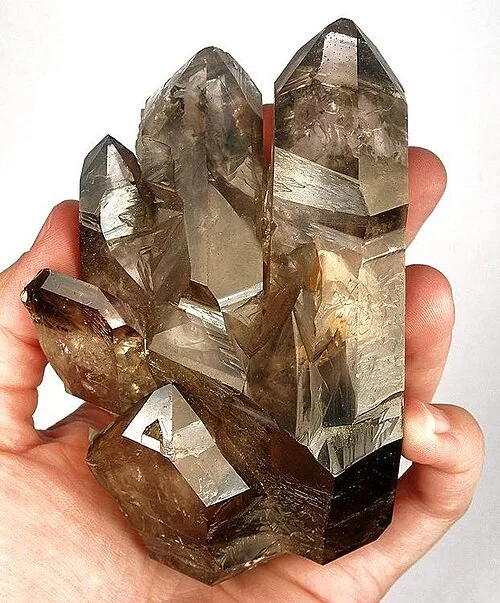
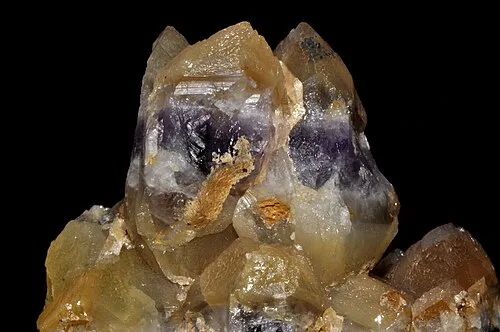
Amethyst, the purple variety, runs from light lilac to deep royal purple and from brownish to vivid, and commonly shows angular zones of darker and lighter color. Citrine is yellow to orangy red, colored by a trace of iron. Natural citrine is rare, and most citrine on the market is heat-treated amethyst; whole amethyst geodes from Brazil are often heated to become citrine. In Bolivia the two colors occur in one crystal, and those stones are sold as ametrine. Smoky quartz is light brown to black and rose quartz a light to medium pink; both share the properties of the species.
Read the full entryColor: hue, tone, saturation and chromophores
Color centers are lattice defects that trap an electron or leave an electron gap, usually after radiation. Smoky quartz needs aluminum substituting for silicon, present in most quartz at the several hundred ppm level, before radiation can create the brown-black hole center. Amethyst is a similar center built on iron. Heating smoky quartz to about 400°C empties the traps and returns it to colorless.
Read the full entryHeat treatment and the no-heat premium
Heating is the oldest and most widespread gem treatment. SSEF places commercial heating of corundum in a range of roughly 700 to 1,800 °C, dividing low-temperature work below about 1,000 °C from high-temperature work above about 1,200 °C. Past that upper figure the fine rutile needles called silk dissolve and expansion cracks open around inclusions; GIA’s 2019 Madagascar heating experiments recorded deeper, more saturated blue in stones taken that high. Heat also converts amethyst to citrine, and GIA states that most citrine sold is heated amethyst because natural citrine is rare. GIA describes aquamarine as routinely heated to remove greenish tints. LMHC Information Sheet #15 of 2025 calls tanzanite commonly heated and adds that the treatment is sometimes not determinable.
Read the full entryGems in scripture and sacred astrology
The Book of Revelation (21:19-20) rests the wall of the heavenly Jerusalem on twelve jeweled foundations, from jasper and sapphire to jacinth and amethyst. The first-century historian Josephus said of the twelve stones that whether one understands by them the months or the signs of the zodiac, one will not mistake their meaning. That reading underlies later birthstone customs.
Read the full entryCrystal healing and metaphysical beliefs
Crystal healing is the belief that quartz points, amethyst clusters and other stones can improve physical or emotional health when held, worn or placed on the body, supposedly by transmitting or balancing a form of energy. It draws on much older lapidary traditions, books that assigned medicinal virtues to each stone, and it spread through English-speaking countries with the New Age movement of the late 20th century.
Read the full entryMourning jewelry, talismans and amulets
Amulets are among the oldest uses of gems. Ancient Egyptians wore and buried protective charms of carnelian, lapis lazuli and turquoise, including scarabs and the eye of Horus. Pliny the Elder recorded with derision the claim of the Magi that amethyst kept its wearer from drunkenness; he traced the name instead to the stone's color, close to wine and then fading into violet. Protective traditions continue in evil-eye charms and navaratna jewelry; there is no evidence that stones protect their wearers.
Read the full entry
Cleaning and wear.
From the care table in Chapter 22.
| Stone | Ultrasonic | Steam | Notes |
|---|---|---|---|
| Amethyst | Caution | Avoid | Ultrasonic usually safe except for dyed or fracture-filled stones; sudden heat can fracture it. |
Print the care chart for all 25 stones A4 · PDF · 133 kBUS Letter · PDF · 132 kB
Buy or sell with a laboratory report
On the Erebaur market every buyer and seller is verified, every stone has a report from an independent laboratory and every payment goes into escrow.