- Mohs
- 6.5–7
- RI
- 1.535–1.539
- SG
- 2.6
- Crystal system
- trigonal (microcrystalline)
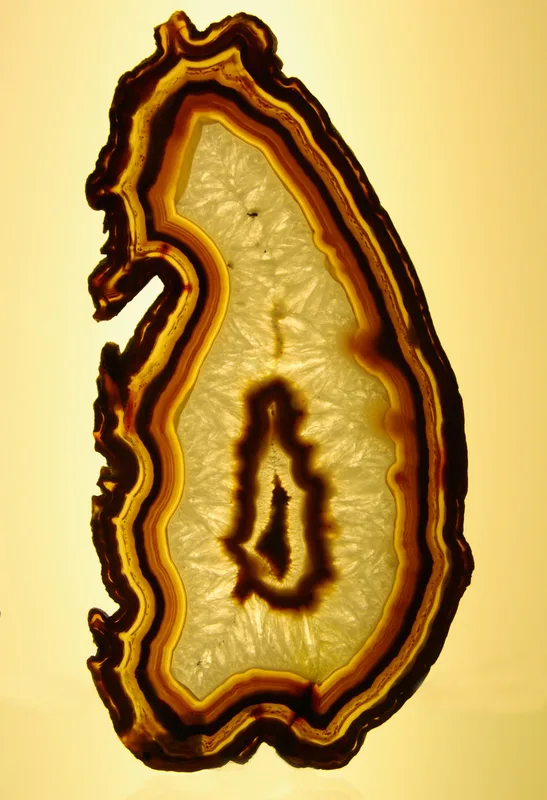
Agate at a glance.
- Species
- Quartz (chalcedony)
- Formula
- SiO₂
- Crystal system
- trigonal (microcrystalline)
- Mohs
- 6.5–7
- RI
- 1.535–1.539
- SG
- 2.6
- Colors
- banded, many colors
What the encyclopedia says.
6 passages, quoted as published. Each links to the full entry and the sources of its chapter.
The quartz family
Chalcedony varieties are named by color and pattern. Agate is banded, and onyx has straight parallel bands; most black onyx in commerce is dyed. Carnelian is orange to red, chrysoprase apple green and jasper the opaque, often patterned member of the family. Much commercial chalcedony is dyed or heated.
Read the full entryLabradorescence, aventurescence, color change, iridescence
Iridescence is structural color made by interference of reflected or diffracted light from submicron structures. It appears in fire agate, in the surface orient of fine pearls and along thin air-filled cracks in quartz.
Read the full entryColored-stone and auction centers
Idar-Oberstein in western Germany has cut agate and other chalcedony for more than 500 years, using sandstone wheels turned by water from the Nahe and nearby streams. Local deposits were largely worked out by the middle of the 19th century, after which its workshops imported rough from Brazil. It remains Europe’s main colored-stone processing town. The town also has its own exchange, the Diamant- und Edelsteinbörse Idar-Oberstein (DEIO), founded in 1974 as the first combined diamond and gemstone exchange in the world and affiliated to the WFDB. Geneva plays a different part: Sotheby’s holds its High Jewelry and Royal & Noble Jewels sales in the city.
Read the full entryCarving, cameos and intaglios
Gem carving is far older than faceting. An intaglio has its design cut into the surface, in sunken relief, so that pressed into wax or clay it leaves a raised image; the British Museum notes that such gems were often used as seals as well as being luxury objects. A cameo is the reverse, with the design raised in relief. The Metropolitan Museum dates the change to about the fifth century BCE, when Greek carvers began engraving stones in projected relief, and credits the Hellenistic Greeks with being the first to excel at it. Carvers favor banded stones such as sardonyx, onyx and agate, playing a pale layer against a dark ground. The cutting was done not with the point of the drill but by using the drill to rub abrasive powders into the stone.
Read the full entryCarving, cameos and intaglios
Idar-Oberstein has worked agate from the Nahe valley since the 1400s. Nephrite is shaped by abrasion: the Liangzhu culture of about 3300 to 2250 BCE ground it into disks (bi) and tubes (cong) placed with the dead.
Read the full entryCoating, dyeing and bleaching
Dyeing needs somewhere for color to go. Gem-A notes that stones are soaked in pigment solutions, sometimes after heating or chemical attack has opened fractures and pore spaces, and lists jadeite, opal, lapis lazuli, pearls, corundum and quartz among commonly dyed materials, along with quartzite, magnesite and marble used as simulants. Idar-Oberstein has colored agate by inorganic chemistry for generations, and a sugar route makes black agate. Dye concentrates in cracks and pores, and an acetone swab can pick up the color.
Read the full entry
Buy or sell with a laboratory report
On the Erebaur market every buyer and seller is verified, every stone has a report from an independent laboratory and every payment goes into escrow.