- Mohs
- 7
- RI
- 1.544–1.553
- SG
- 2.64–2.69
- Crystal system
- trigonal
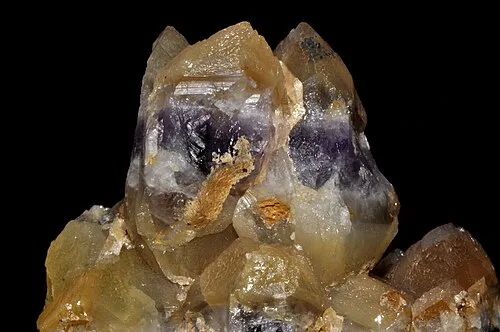
Citrine at a glance.
- Species
- Quartz
- Formula
- SiO₂
- Crystal system
- trigonal
- Mohs
- 7
- RI
- 1.544–1.553
- SG
- 2.64–2.69
- Colors
- yellow to orange to orangy red
What the encyclopedia says.
2 passages, quoted as published. Each links to the full entry and the sources of its chapter.
The quartz family
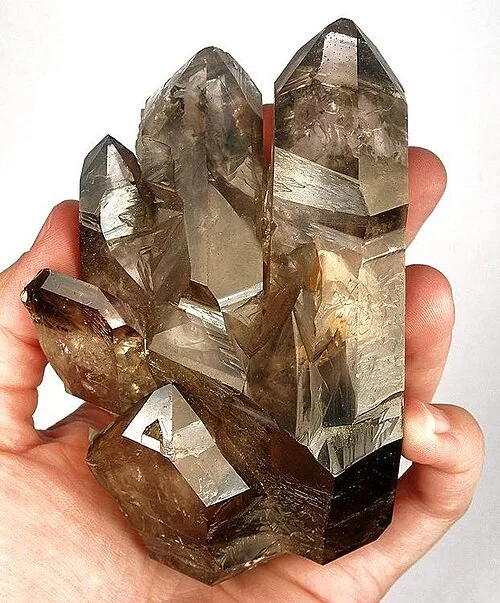
Amethyst, the purple variety, runs from light lilac to deep royal purple and from brownish to vivid, and commonly shows angular zones of darker and lighter color. Citrine is yellow to orangy red, colored by a trace of iron. Natural citrine is rare, and most citrine on the market is heat-treated amethyst; whole amethyst geodes from Brazil are often heated to become citrine. In Bolivia the two colors occur in one crystal, and those stones are sold as ametrine. Smoky quartz is light brown to black and rose quartz a light to medium pink; both share the properties of the species.
Read the full entryHeat treatment and the no-heat premium
Heating is the oldest and most widespread gem treatment. SSEF places commercial heating of corundum in a range of roughly 700 to 1,800 °C, dividing low-temperature work below about 1,000 °C from high-temperature work above about 1,200 °C. Past that upper figure the fine rutile needles called silk dissolve and expansion cracks open around inclusions; GIA’s 2019 Madagascar heating experiments recorded deeper, more saturated blue in stones taken that high. Heat also converts amethyst to citrine, and GIA states that most citrine sold is heated amethyst because natural citrine is rare. GIA describes aquamarine as routinely heated to remove greenish tints. LMHC Information Sheet #15 of 2025 calls tanzanite commonly heated and adds that the treatment is sometimes not determinable.
Read the full entry
Cleaning and wear.
From the care table in Chapter 22.
| Stone | Ultrasonic | Steam | Notes |
|---|---|---|---|
| Citrine | Caution | Avoid | Ultrasonic usually safe except for rare dyed or filled stones; GIA says citrine should not be heated. |
Print the care chart for all 25 stones A4 · PDF · 133 kBUS Letter · PDF · 132 kB
Buy or sell with a laboratory report
On the Erebaur market every buyer and seller is verified, every stone has a report from an independent laboratory and every payment goes into escrow.