Diamond
Diamond · C. Colors: colorless to yellow or brown; fancy colors.
- Mohs
- 10
- RI
- 2.42
- SG
- 3.51–3.53
- Crystal system
- cubic
Diamond at a glance.
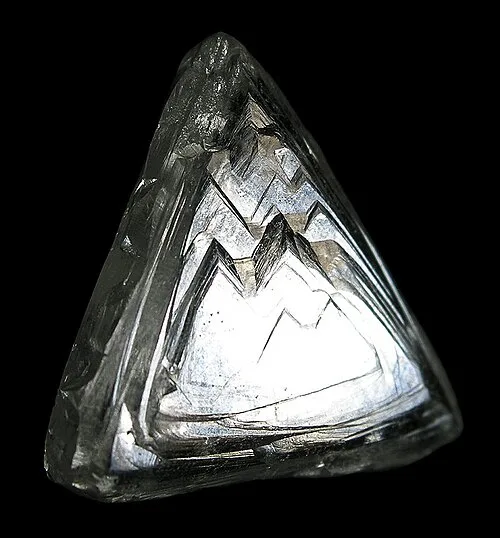
- Species
- Diamond
- Formula
- C
- Crystal system
- cubic
- Mohs
- 10
- RI
- 2.42
- SG
- 3.51–3.53
- Colors
- colorless to yellow or brown; fancy colors
What the encyclopedia says.
8 passages, quoted as published. Each links to the full entry and the sources of its chapter.
Diamond types and black diamonds
Type Ia diamonds, more than 95% of natural stones, hold nitrogen in aggregates. Type Ib diamonds, a rare few, contain isolated nitrogen atoms and are almost always brown, yellow or orange. Type IIa diamonds have no easily measurable nitrogen or boron; the Golconda region of India is their historic source. Type IIb diamonds contain boron, which gives them their blue or gray color and their electrical conductivity; most come from India and the Cullinan mine in South Africa. Laboratories also use type as an early clue when screening for treatment or laboratory growth.
Read the full entryNitrogen, boron and diamond types
Type II diamonds have no nitrogen detectable by FTIR, and they too occur very rarely in nature. Type IIa stones are often exceptionally colorless, and the largest gem diamonds, the Cullinan-like stones that formed 360 to 750 km down, routinely qualify as IIa. Type IIb diamonds contain boron, which colors them blue or gray and makes them electrically conductive. Type matters in practice: IIa is the usual type of CVD-grown diamond and the type HPHT treatment can decolorize, so IIa stones are routinely referred for laboratory testing.
Read the full entryDiamonds in Africa
South Africa’s modern industry began at Kimberley, where miners dug the Big Hole between 1871 and 1914. Cullinan, now owned by Petra Diamonds, produced the 3,106.75 ct Cullinan diamond in 1905 and is the only significant source of blue diamonds. In Namibia, marine operations supply more than three-quarters of production. Angola’s Catoca pipe is owned 59% by the state company Endiama; the other 41%, formerly held by the sanctioned Russian miner Alrosa, passed to an Omani investor in November 2024. Around Mbuji-Mayi in the Democratic Republic of the Congo, diggers work vast deposits once dominated by the state company MIBA. In Sierra Leone, the Koidu kimberlite mine halted in 2025 after a labor dispute, idling the country’s largest diamond company; national output fell from 573,983 carats in 2024 to 121,620 in 2025.
Read the full entryDiamond trading and cutting hubs
Ramat Gan, beside Tel Aviv, holds the Israel Diamond Exchange. In New York, the district on 47th Street between Fifth Avenue and Avenue of the Americas is organized around the Diamond Dealers Club, whose roughly 1,800 members handled more than 95% of the diamonds imported into the United States according to a 2009 law review study. The Dubai Diamond Exchange sits inside the DMCC free zone, which recorded US$41.7 billion of diamond trade in 2025 against US$38.3 billion in 2023 and calls itself the largest platform for diamond tenders. Hong Kong serves Asia as a polished and jewelry market and hosts the HKTDC Hong Kong International Jewellery Show each March, which drew 2,353 exhibitors and 51,054 buyers in 2026.
Read the full entryDiamond testers
Synthetic moissanite defeated the test in the late 1990s: GIA reported that thermal probes react to it as if it were diamond. GIA gives diamond a thermal inertia of 0.55 to 1.7 and moissanite 1.6 to 4.8 in cal/cm C, ranges that overlap. Later multi-testers added electrical conductivity, since moissanite is a semiconductor. That cross-check has its own trap: boron-bearing type IIb diamond conducts too, and GIA reports that over 80% of colorless HPHT laboratory-grown diamonds submitted to it since 2020 are type IIb, so a conductive reading is not proof of moissanite. A loupe helps only if used correctly. Moissanite is cut with its c-axis perpendicular to the table, so face-up it shows no doubling; tilt it and look in at an angle and the back facet junctions double. It is also lighter, 3.22 against diamond’s 3.52.
Read the full entryColored stones and diamonds compared
Colored stones have no common price list, their prices depend heavily on origin and treatment, and the market is watched mainly through dealer guides and auction results. The longest comparison built from completed transactions comes from Luc Renneboog and Christophe Spaenjers, who used 3,952 Sotheby's and Christie's lots sold between 1999 and 2010 to build separate indices for white diamonds, colored diamonds and other gems. Average real returns in US dollars over the full period were 6.4% a year for white diamonds and 2.9% for colored diamonds, against 11.6% for gold and −0.1% for equities. From 2003 the figures were 10.0% for white diamonds, 5.5% for colored diamonds and 6.8% for other gems. Auction lots are drawn from the top of the market, so they describe what exceptional stones did, not what an average buyer would have seen.
Read the full entryConflict diamonds in Sierra Leone, Angola and Liberia
In Angola, the UNITA rebel movement is estimated to have earned US$600 to 700 million from diamonds between 1992 and 1994. The UN Security Council banned purchases of Angolan diamonds lacking government certificates in June 1998, and Global Witness’s December 1998 report A Rough Trade named the companies and governments involved. In Sierra Leone, the RUF rebel group held diamond areas during a civil war from 1991 to 2002 that killed about 75,000 people and became notorious for the mutilation of civilians. Neighboring Liberia, under President Charles Taylor, traded weapons for RUF diamonds and exported them as its own, and the Security Council banned Liberian rough diamond exports in March 2001. The Special Court for Sierra Leone convicted Taylor in 2012 and sentenced him to 50 years in prison.
Read the full entryG7 and EU bans on Russian diamonds
Russia’s state-controlled Alrosa is the world’s largest diamond miner by volume. After Russia invaded Ukraine, the United States banned imports of Russian non-industrial diamonds in March 2022 (Executive Order 14068) and designated Alrosa in April 2022 (Executive Order 14024). G7 leaders agreed on December 6, 2023 to restrict Russian diamonds, and the EU’s 12th sanctions package of December 18 set the timetable. Diamonds mined, processed or exported from Russia were banned from January 1, 2024. Russian diamonds cut in third countries were banned from March 1, 2024 at 1.0 ct and above, and from September 1, 2024 at 0.5 ct and above. The US applied the same thresholds.
Read the full entry
Where it is mined.
Localities from the mine map in Chapter 05.
| Locality | Country | Status | Note |
|---|---|---|---|
| Catoca | Angola | active | Large kimberlite mine in Lunda Sul; Endiama 59%, Omani investor 41% since 2024 |
| Argyle | Australia | closed | Rio Tinto, 1985–2020; supplied over 90% of the world’s pink diamonds |
| Jwaneng | Botswana | active | Debswana open pit, opened 1982; mining at about 452 m and planned to reach 816 m by 2034 |
| Karowe | Botswana | active | Lucara open pit on the AK6 pipe, producing since 2012; source of the 1,109 ct Lesedi La Rona (2015) and the 2,488 ct Motswedi (2024) |
| Orapa | Botswana | active | Debswana mine opened in 1971; largest diamond mine by area |
| Diavik | Canada | closed | Rio Tinto mine under Lac de Gras; final production March 2026 after more than 150 million ct |
| Ekati | Canada | closed | Canada’s first diamond mine (1998); receivership on 14 July 2026 ended mining as a going concern; wind-down of about five weeks, now care and maintenance |
| Gahcho Kué | Canada | active | De Beers 51%, Mountain Province 49%; opened 2016, production expected to end in late 2027 |
| Mbuji-Mayi | DR Congo | artisanal | Kasai diamond fields developed by MIBA; widely worked by artisanal diggers |
| Kollur (Golconda workings) | India | historic | Alluvial workings of the Golconda group on the Krishna; Indian output peaked in the 1600s, and Brazilian finds of the early 1700s ended its lead |
| Letseng | Lesotho | active | Gem Diamonds 70%, Lesotho 30%; the highest diamond mine at about 3,100 m, worked for large high-value stones |
| Namibian marine fields | Namibia | active | Debmarine Namibia’s Atlantic 1 license; seabed gravels mined at 90–140 m depth (approximate center) |
| Jubilee (Yubileynaya) | Russia | active | Alrosa open pit about 20 km from Aikhal, Yakutia |
| Mir | Russia | closed | Alrosa pipe at Mirny, Yakutia; open pit ended 2001, underground mine flooded in 2017; a separate deeper mine is being sunk on the site |
| Udachny | Russia | active | Alrosa pipe in Yakutia; open pit about 640 m deep, now mined underground |
| Koidu | Sierra Leone | closed | Kimberlite mine in Kono district; operations halted in 2025 after a labor dispute |
| Cullinan | South Africa | active | Petra Diamonds; source of the 3,106.75 ct Cullinan diamond (1905) |
| Finsch | South Africa | closed | Petra Diamonds kimberlite mine at Lime Acres, Northern Cape; in business rescue, production suspended on 10 June 2026 |
| Kimberley (Big Hole) | South Africa | historic | Worked 1871–1914 to 240 m; about 14.5 million ct recovered |
| Venetia | South Africa | active | De Beers mine in Limpopo; moved from open pit to underground mining |
| Williamson (Mwadui) | Tanzania | active | Mwadui pipe, about 146 ha at surface; source of the Williamson Pink (1947); Petra sold its stake in May 2025 |
| Marange (Chiadzwa) | Zimbabwe | active | Diamonds in weathered Umkondo conglomerate, rushed from 2006; operators folded into the state company ZCDC in 2016 |
Cleaning and wear.
From the care table in Chapter 22.
| Stone | Ultrasonic | Steam | Notes |
|---|---|---|---|
| Diamond | Caution | Caution | GIA advises against ultrasonic and steam cleaners at home because vibration can loosen settings; jewelers inspect pieces first. |
Print the care chart for all 25 stones A4 · PDF · 133 kBUS Letter · PDF · 132 kB
Stones with a name.
| Name | Type | Carats | Origin | Where now |
|---|---|---|---|---|
| Cullinan I (Great Star of Africa) | Colorless diamond, drop shape | 530.2 | Cullinan mine (Premier), South Africa, 1905 | Sovereign’s Sceptre with Cross, Tower of London |
| Cullinan II (Second Star of Africa) | Colorless diamond, cushion | 317.4 | Cullinan mine (Premier), South Africa, 1905 | Imperial State Crown, Tower of London |
| Koh-i-Noor | Colorless diamond | 105.6 | India, probably the Golconda mines | Crown of Queen Elizabeth the Queen Mother, Tower of London |
| Hope Diamond | Blue diamond, Type IIb | 45.52 | India; the exact mine is not established | Smithsonian National Museum of Natural History, Washington |
| Regent | Colorless diamond | 140.64 | Mines of Golconda, India, found 1698 | Musée du Louvre, Paris; off display since July 2026 |
| Sancy | Diamond, asymmetrical pear shape | 55 | Not established | Musée du Louvre, Paris; off display since July 2026 |
| Hortensia | Pink diamond, slightly brown-orange | 20 | Not established | Musée du Louvre, Paris; off display since July 2026 |
| Orlov | Colorless diamond, rose cut | – | Golconda region, India, per GIA | Imperial Sceptre, Diamond Fund, Moscow Kremlin |
| Dresden Green | Green diamond | 41 | India; the exact mine is not recorded | Neues Grünes Gewölbe, Dresden |
| Darya-i-Noor | Pale pink diamond | 182 | India | Treasury of National Jewels, Central Bank of Iran, Tehran |
Records at auction.
| Stone | Carats | US$ million | House | Date |
|---|---|---|---|---|
| CTF Pink StarFancy Vivid Pink diamond, oval mixed cut, IF | 59.6 | 71.2 | Sotheby's, Hong Kong | 2017-04 |
| Williamson Pink StarFancy Vivid Pink diamond, cushion, IF | 11.15 | 57.7 | Sotheby's, Hong Kong | 2022-10 |
| Oppenheimer BlueFancy Vivid Blue diamond, rectangular cut, VVS1 | 14.62 | 57.54 | Christie's, Geneva | 2016-05 |
| De Beers BlueFancy Vivid Blue diamond, step cut, IF | 15.1 | 57.5 | Sotheby's, Hong Kong | 2022-04 |
| Pink LegacyFancy Vivid Pink diamond, cut-cornered rectangle, VS1 | 18.96 | 50.4 | Christie's, Geneva | 2018-11 |
| Blue Moon of JosephineFancy Vivid Blue diamond, cushion, IF | 12.03 | 48.5 | Sotheby's, Geneva | 2015-11 |
| Graff PinkPink diamond, emerald cut, repolished after the sale | 24.78 | 46.0 | Sotheby's, Geneva | 2010-11 |
| Bleu RoyalFancy Vivid Blue diamond, pear brilliant, IF | 17.61 | 44.0 | Christie's, Geneva | 2023-11 |
| PrincieFancy Intense Pink diamond, cushion, VS2, Golconda type | 34.65 | 39.3 | Christie's, New York | 2013-04 |
| Eternal PinkFancy Vivid purplish pink diamond, IF | 10.57 | 34.8 | Sotheby's, New York | 2023-06 |
Seen the one
you want?
Name it in a brief. We find it in any producing country and have it tested independently.