Nephrite
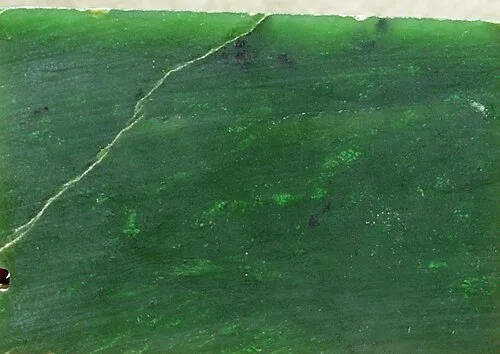
Actinolite-tremolite · Ca₂(Mg,Fe)₅Si₈O₂₂(OH)₂. Colors: light to dark green, yellow, brown, black, gray, white.
- Mohs
- 6–6.5
- RI
- 1.606–1.632
- SG
- 2.95
- Crystal system
- monoclinic (aggregate)
Nephrite at a glance.
- Species
- Actinolite-tremolite
- Formula
- Ca₂(Mg,Fe)₅Si₈O₂₂(OH)₂
- Crystal system
- monoclinic (aggregate)
- Mohs
- 6–6.5
- RI
- 1.606–1.632
- SG
- 2.95
- Colors
- light to dark green, yellow, brown, black, gray, white
What the encyclopedia says.
8 passages, quoted as published. Each links to the full entry and the sources of its chapter.
Jade: jadeite and nephrite
Jade is a trade name. GIA applies it to nephrite, jadeite and, under certain conditions, green omphacite, all of them dense mats of interlocking microscopic crystals. In 1863 the French mineralogist Alexis Damour analyzed bright green jades from Burma, found them different from the amphibole jade long known in China, and named the mineral jadeite.
Read the full entryJade: jadeite and nephrite
Nephrite lies in the actinolite-tremolite series of amphiboles. It is softer at 6–6.5 and lighter at 2.95, but its felted fibrous texture makes it supremely tough among rocks. Its historic Chinese source was south of Hotan, in the Kunlun mountains. CIBJO gives the correct trade names as jadeite or jadeite-jade and nephrite or nephrite-jade, and requires disclosure of the polymer impregnation and dyeing commonly applied to jadeite.
Read the full entryHardness, toughness, cleavage and stability
Toughness is resistance to breaking and chipping, and it is independent of hardness. Jadeite rates 6.5 to 7 and nephrite 6 to 6.5, yet both are extremely tough, which is why Neolithic knives and axe heads were often made of nephrite. Diamond, the hardest natural gem, can still split under a sharp blow: it has four perfect cleavage directions, parallel to its triangular octahedral faces. Topaz has one perfect cleavage, on {001}, and kunzite two. Where no cleavage exists a stone breaks by fracture; quartz and glass show curved, shell-like conchoidal fracture.
Read the full entryJade grading
The word jade covers jadeite, a sodium aluminum pyroxene (NaAlSi₂O₆), and nephrite, a rock of densely interlocked fibres of the tremolite–actinolite amphibole series. GIA now counts green omphacite as a third jade. All are aggregates of tiny interlocking crystals, which makes them exceptionally tough. GIA ranks jadeite on three factors. Color comes first: imperial jade, a vivid green with no hint of gray, sits at the top, and lavender is next. Transparency runs from opaque to semitransparent, and in the best material text read through a thin piece is only slightly blurred. Texture describes grain size as fine, medium or coarse.
Read the full entryJade grading
Treatment status matters as much as appearance, and the trade uses letter shorthand. A-jade is untreated. B-jade has been bleached and impregnated with resin or wax. C-jade has been dyed, and B+C jade is both. The LMHC recommends that reports state the treatment in plain words, such as “dyed” or “impregnated,” rather than the letters. Laboratories detect fillers and dyes with infrared and Raman spectroscopy and with ultraviolet to near-infrared absorption spectroscopy.
Read the full entryCoating, dyeing and bleaching
Bleaching removes color. GIA states that akoya and freshwater cultured pearls are routinely processed, bleaching being the most common step. In jadeite, acid bleaching strips iron compounds from fractures and grain boundaries and leaves material so brittle that samples crumbled under finger pressure, so polymer impregnation follows. The LMHC reports the result as impregnated with resin or wax, known in the trade as B-jade, and dyed jadeite as C-jade, and says light surface waxing need not be declared.
Read the full entryMyanmar ruby and jade sanctions
Myanmar supplies most of the world’s fine jadeite, from Hpakant in Kachin State, and many of its finest rubies, from the Mogok valley. For decades revenue flowed to military governments and their business allies, while fighting between the army and the Kachin Independence Army affected the jade areas. Global Witness put Myanmar's jade trade at up to US$31 billion in 2014, a modelled NGO estimate rather than audited trade data.
Read the full entryMyanmar ruby and jade sanctions
The United States responded with the Tom Lantos Block Burmese JADE Act, signed on July 29, 2008. It banned imports of Burmese jadeite and rubies, and jewelry containing them, even when cut or set in another country, closing the route by which rubies cut in Thailand entered the US market. Executive Order 13742 of October 7, 2016 terminated that ban, and Customs and Border Protection removed the implementing regulation on October 30, 2017. No US import ban has applied since.
Read the full entry
Cleaning and wear.
From the care table in Chapter 22.
| Stone | Ultrasonic | Steam | Notes |
|---|---|---|---|
| Jade (jadeite, nephrite) | Caution | Caution | Safe for untreated jade; dyed, bleached, impregnated or coated jade should get warm soapy water only. |
Print the care chart for all 25 stones A4 · PDF · 133 kBUS Letter · PDF · 132 kB
Seen the one
you want?
Name it in a brief. We find it in any producing country and have it tested independently.