Paraíba tourmaline
Elbaite · Na(Li₁.₅,Al₁.₅)Al₆Si₆O₁₈(BO₃)₃(OH)₄. Colors: intense violetish blue, greenish blue, blue.
- Mohs
- 7–7.5
- RI
- 1.624–1.644
- SG
- 3–3.26
- Crystal system
- trigonal
Paraíba tourmaline at a glance.
- Species
- Elbaite
- Formula
- Na(Li₁.₅,Al₁.₅)Al₆Si₆O₁₈(BO₃)₃(OH)₄
- Crystal system
- trigonal
- Mohs
- 7–7.5
- RI
- 1.624–1.644
- SG
- 3–3.26
- Colors
- intense violetish blue, greenish blue, blue
What the encyclopedia says.
4 passages, quoted as published. Each links to the full entry and the sources of its chapter.
Tourmaline
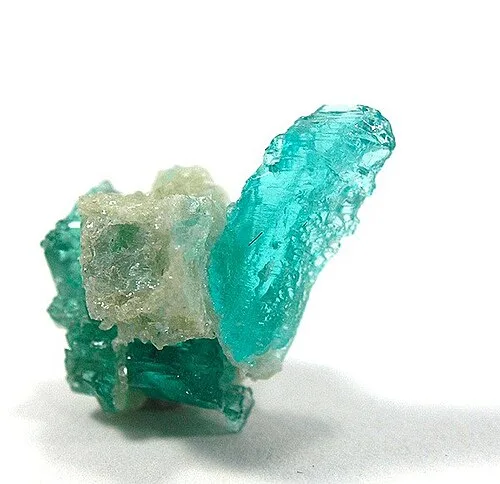
Trade names follow color. Iron, and possibly titanium, are generally held to cause green and blue; manganese produces reds and pinks. Rubellite is pink, red, purplish red, orangy red or brownish red. Indicolite is dark violetish blue, blue or greenish blue. Paraíba tourmaline, from the Brazilian state of that name, is an intense violetish blue, greenish blue or blue colored by copper. Chrome tourmaline, from Tanzania, is intense green but is colored mostly by vanadium, not by the chromium its name suggests.
Read the full entryApatite, sphene, andalusite, kyanite, diopside, fluorite
Apatite, Ca₅(PO₄)₃(F,OH,Cl), defines 5 on the Mohs scale. It comes in many colors, and neon blue-green stones from Madagascar resemble copper-bearing Paraíba tourmaline, though they scratch far more easily.
Read the full entryTanzanite, tourmaline, jade, lapis, turquoise, opal
Minas Gerais in Brazil yields aquamarine, topaz and tourmaline in almost every color from granitic pegmatites, and Teófilo Otoni is its main gem-trading city. Copper-bearing “Paraíba” tourmaline, a vivid blue to green, reached the international gem market in 1989 from São José da Batalha in Paraíba state; similar material later came from Rio Grande do Norte, Nigeria and Mozambique.
Read the full entryOrigin reports and their scientific limits
An origin report gives a laboratory's opinion on where a stone was most likely mined. GIA offers it for ruby, sapphire, emerald, Paraíba tourmaline, red spinel and alexandrite, and says it cannot reach a determination in every case. The evidence comes from three directions. Inclusions, the crystals, fluids and growth features trapped inside, reflect the rock the stone grew in. Trace-element chemistry, measured by laser ablation inductively coupled plasma mass spectrometry (LA-ICP-MS), gives a chemical signature. Spectroscopy adds absorption and luminescence data. Each result is compared with reference collections gathered as close to the mine as possible.
Read the full entry
Where it is mined.
Localities from the mine map in Chapter 05.
| Locality | Country | Status | Note |
|---|---|---|---|
| São José da Batalha | Brazil | artisanal | Source of the first Paraíba tourmaline, which reached the gem market in 1989 (approximate location) |
Seen the one
you want?
Name it in a brief. We find it in any producing country and have it tested independently.