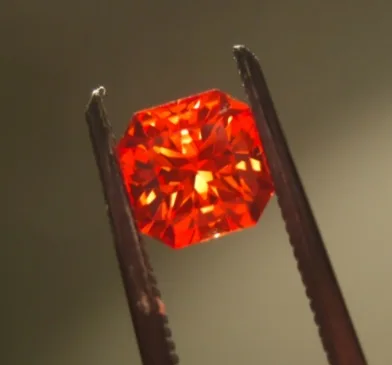
Padparadscha sapphire
Corundum · Al₂O₃. Colors: pinkish orange to orangy pink.
- Mohs
- 9
- RI
- 1.762–1.77
- SG
- 3.95–4.05
- Crystal system
- trigonal
Padparadscha sapphire at a glance.
- Species
- Corundum
- Formula
- Al₂O₃
- Crystal system
- trigonal
- Mohs
- 9
- RI
- 1.762–1.77
- SG
- 3.95–4.05
- Colors
- pinkish orange to orangy pink
What the encyclopedia says.
3 passages, quoted as published. Each links to the full entry and the sources of its chapter.
Corundum: ruby and sapphire
Blue sapphire owes its color to iron and titanium, a few hundredths of a percent of each, and more iron means a darker blue. Padparadscha is a rare pinkish orange sapphire named after the lotus flower. Corundum of every other hue, including violet, green, yellow, orange, pink and purple, along with parti-colored stones, is sold as fancy sapphire. Color-change sapphires most often shift from blue in daylight or fluorescent light to purple under incandescent light.
Read the full entryTrade color names and the standardization debate
Some color descriptions carry a price of their own. Pigeon's blood names the finest red ruby and royal blue a deep, saturated sapphire. Cornflower names a softer blue; GIA's origin research ties the velvety look prized in Kashmir stones to dense milky inclusion bands. Padparadscha, from a Sinhalese term for lotus color, names a sapphire between pink and orange.
Read the full entryTrade color names and the standardization debate
Each laboratory writes its own definition. GRS says it published pigeon's blood, cornflower blue and royal blue in 1996, and it ties pigeon's blood to a vivid red of low tone, medium to strong ultraviolet fluorescence and a chromium to iron ratio above one. On November 4, 2015, SSEF and the Gübelin Gem Lab agreed shared criteria for pigeon blood red and royal blue: intense, saturated, evenly distributed color, few eye-visible inclusions and no treatment of any kind, heating included. Neither GRS nor the Swiss pair limits the terms to one country. The LMHC defines padparadscha as a subtle mixture of pinkish orange to orangey pink, pastel in tone, low to medium in saturation, seen in standard daylight and from any origin.
Read the full entry
Seen the one
you want?
Name it in a brief. We find it in any producing country and have it tested independently.