Ruby
Corundum · Al₂O₃. Colors: orangy red to purplish red.
- Mohs
- 9
- RI
- 1.762–1.77
- SG
- 3.95–4.05
- Crystal system
- trigonal
Ruby at a glance.
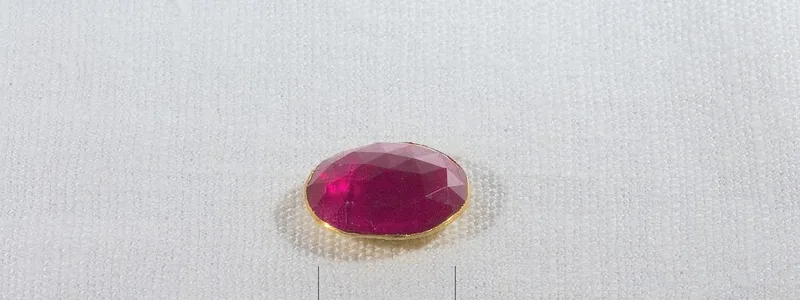
- Species
- Corundum
- Formula
- Al₂O₃
- Crystal system
- trigonal
- Mohs
- 9
- RI
- 1.762–1.77
- SG
- 3.95–4.05
- Colors
- orangy red to purplish red
What the encyclopedia says.
8 passages, quoted as published. Each links to the full entry and the sources of its chapter.
Corundum: ruby and sapphire
Corundum is aluminum oxide, Al₂O₃, rated 9 on the Mohs scale, with a refractive index of 1.762–1.770 and a specific gravity of 4.00. Pure corundum is colorless, and trace elements produce its colors. Stones colored red by chromium are ruby, in hues from orangy red to purplish red; the more chromium, the stronger the red. Chromium also causes fluorescence. Rubies formed in marble contain little iron, so their red fluorescence survives and shows even in sunlight.
Read the full entrySpinel
For centuries red spinel was not distinguished from ruby, and many of the famous historical "rubies" are spinels. Two of the best-known in the British crown jewels, the Black Prince's Ruby and the Timur Ruby, are red spinel. The mineralogist Jean Baptiste Louis Rome de Lisle separated spinel from ruby as a distinct mineral.
Read the full entryMetamorphic deposits: marble-hosted rubies
GIA’s review of corundum deposits puts ruby growth in these marbles at roughly 620–670 °C and 2.6–3.3 kbar. The crystals sit scattered through the rock with phlogopite, muscovite, scapolite, margarite, spinel, titanite, pyrite and graphite, which is why fine red spinel comes out of the same workings, Mogok above all. The Mogok Stone Tract in Myanmar has produced pigeon’s blood rubies since about 600 CE.
Read the full entryRubies and sapphires in Asia
Rubies and sapphires are both corundum, crystalline aluminum oxide colored by trace elements: chromium makes ruby red, and iron with titanium makes sapphire blue. Mogok, in Myanmar’s Mandalay Region, has supplied fine rubies for centuries, along with sapphire, spinel and peridot, mostly from small pits and hand panning. The town became a front line in Myanmar’s civil war: the Ta’ang National Liberation Army captured it in July 2024 and withdrew after a China-brokered ceasefire in October 2025.
Read the full entryRubies and sapphires: Africa, Montana, Australia
Mozambique became a leading ruby source after deposits near Montepuez in Cabo Delgado province became widely known in 2009. Montepuez Ruby Mining, owned 75% by Gemfields and 25% by the Mozambican company Mwiriti, began mining in 2012 on a 33,600-hectare concession and sells its rough at auction. Madagascar’s Ilakaka rush followed the 1998 discovery of a large alluvial sapphire deposit; the new town’s population reached nearly 60,000 by 2005.
Read the full entryMuseum sapphires, rubies and emeralds
The Star of India, a Sri Lankan star sapphire of just over 563 carats, is the largest gem-quality star sapphire known. Its six-rayed star, or asterism, comes from light reflecting off needles of rutile, which the American Museum of Natural History describes as a flaw rather than a virtue. On 29 October 1964 Jack Murphy and two accomplices took it from the museum’s old Morgan Memorial Hall along with the DeLong Star Ruby, the Midnight Star, the Schettler Emerald and nearly all the diamonds. Arrests came quickly and most of the notable stones returned. The DeLong Star Ruby had to be ransomed. About a dozen stones never came back, and they included every diamond.
Read the full entry“Rubies” that are spinel
Before gemologists could measure a stone’s optical properties, red gems of similar color went into one category. Several of the most famous historic “rubies” are spinel, a magnesium aluminum oxide, while ruby is red corundum, an aluminum oxide. Older European inventories called red spinel balas ruby.
Read the full entryRuby lasers and quartz oscillators
On May 16, 1960, Theodore Maiman operated the first laser at Hughes Research Laboratories in Malibu, California, with Irnee D'Haenens and Charles Asawa. Its gain medium was a small rod of synthetic pink ruby, about 1 × 2 cm, with silvered ends and a helical flash lamp around it. Chromium ions (Cr³⁺), the impurity that colors gem ruby, absorbed the flash and emitted coherent red light at 694.3 nm. Hughes announced the result at a press conference on July 7, 1960, and Maiman's paper appeared in Nature on August 6. Other materials soon displaced ruby for most purposes, but ruby fluorescence remains the standard pressure gauge in diamond anvil cells.
Read the full entry
Where it is mined.
Localities from the mine map in Chapter 05.
| Locality | Country | Status | Note |
|---|---|---|---|
| Pailin | Cambodia | historic | Gem fields once a leading sapphire source; exploited by the Khmer Rouge |
| Montepuez | Mozambique | active | Gemfields 75%, Mwiriti 25%; 33,600 ha concession near Montepuez town, mining since 2012 |
| Mogok | Myanmar | artisanal | The classic ruby district; held by TNLA rebels from July 2024 to October 2025 |
| Mong Hsu | Myanmar | artisanal | Shan State, about 250 km southeast of Mogok; marble-hosted ruby with violet cores, on the Bangkok market from 1992 |
| Ratnapura | Sri Lanka | artisanal | Gem gravels worked from hand-dug pits 10–50 m deep |
| Chanthaburi | Thailand | historic | Basalt-related gem gravels, now far less productive; major gem-trading town |
| Luc Yen | Vietnam | artisanal | Yen Bai province; gems found in placers in 1987 and mined from 1988, now worked by small groups of local miners |
Cleaning and wear.
From the care table in Chapter 22.
| Stone | Ultrasonic | Steam | Notes |
|---|---|---|---|
| Ruby (untreated or heated) | Safe | Safe | Also safe for lattice-diffused stones. Boric acid powder etches even untreated corundum. |
| Ruby (glass-filled) | Avoid | Avoid | GIA: high-lead glass is altered by chemicals as mild as lemon juice, so fracture-filled, cavity-filled or dyed ruby takes a damp cloth only. |
Print the care chart for all 25 stones A4 · PDF · 133 kBUS Letter · PDF · 132 kB
Stones with a name.
| Name | Type | Carats | Origin | Where now |
|---|---|---|---|---|
| Rosser Reeves Star Ruby | Star ruby, oval cabochon | 138.7 | Sri Lanka | Smithsonian National Museum of Natural History, Washington |
| DeLong Star Ruby | Star ruby | – | Not established in the records used here | American Museum of Natural History, New York |
Records at auction.
| Stone | Carats | US$ million | House | Date |
|---|---|---|---|---|
| Estrela de FuraRuby, Mozambique, pigeon's blood | 55.22 | 34.8 | Sotheby's, New York | 2023-06 |
| Sunrise RubyRuby, Myanmar, set in a Cartier ring | 25.59 | 30.3 | Sotheby's, Geneva | 2015-05 |
| Jubilee RubyRuby, Burma, unheated, in a Verdura ring | 15.99 | 14.2 | Christie's, New York | 2016-04 |
Seen the one
you want?
Name it in a brief. We find it in any producing country and have it tested independently.