Blue sapphire
Corundum · Al₂O₃. Colors: light to dark blue.
- Mohs
- 9
- RI
- 1.762–1.77
- SG
- 3.95–4.05
- Crystal system
- trigonal
Blue sapphire at a glance.
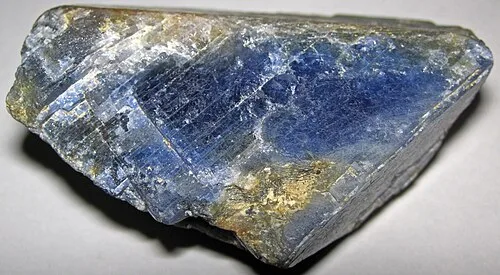
- Species
- Corundum
- Formula
- Al₂O₃
- Crystal system
- trigonal
- Mohs
- 9
- RI
- 1.762–1.77
- SG
- 3.95–4.05
- Colors
- light to dark blue
What the encyclopedia says.
8 passages, quoted as published. Each links to the full entry and the sources of its chapter.
Corundum: ruby and sapphire
Blue sapphire owes its color to iron and titanium, a few hundredths of a percent of each, and more iron means a darker blue. Padparadscha is a rare pinkish orange sapphire named after the lotus flower. Corundum of every other hue, including violet, green, yellow, orange, pink and purple, along with parti-colored stones, is sold as fancy sapphire. Color-change sapphires most often shift from blue in daylight or fluorescent light to purple under incandescent light.
Read the full entryCorundum: ruby and sapphire
Star rubies and star sapphires show asterism, usually a six-rayed star across the curved surface of a cabochon. It arises from white light reflecting off numerous tiny oriented needle-like inclusions; in sapphire these are often the intersecting rutile needles gemologists call silk.
Read the full entryBasalt-related sapphires
Many blue, green and yellow sapphires are recovered from soils and gravels over young alkali basalt fields. Deposits of this kind run from Tasmania through eastern Australia, Southeast Asia and eastern China to far eastern Russia, and are also worked in Nigeria and Cameroon, in Madagascar and at Aksum in Ethiopia. The basalt did not make the gems. The sapphires are xenocrysts, crystals foreign to the lava that carried them, found in flows and plugs of subalkaline olivine basalt, high-alumina alkali basalt and basanite, in crustal settings stretched above rising mantle plumes. Weathering of those flows leaves the alluvial deposits worked today, mainly in northern New South Wales and central Queensland.
Read the full entryBasalt-related sapphires
These sapphires have a recognizable chemistry. In a 2007 study, J.-J. Peucat and colleagues showed that magmatic blue sapphires from alkali basalts carry 2000 to 11000 ppm iron, more than 140 ppm gallium and generally under 20 ppm magnesium, giving gallium-to-magnesium ratios above 10. Metamorphic blue sapphires, including the pastel stones from Pailin in Cambodia and material from Mogok, Sri Lanka and Ilakaka, carry under 3000 ppm iron and sit below a ratio of 10. Laboratories still use that split as one line of evidence.
Read the full entryRubies and sapphires in Asia
Rubies and sapphires are both corundum, crystalline aluminum oxide colored by trace elements: chromium makes ruby red, and iron with titanium makes sapphire blue. Mogok, in Myanmar’s Mandalay Region, has supplied fine rubies for centuries, along with sapphire, spinel and peridot, mostly from small pits and hand panning. The town became a front line in Myanmar’s civil war: the Ta’ang National Liberation Army captured it in July 2024 and withdrew after a China-brokered ceasefire in October 2025.
Read the full entryRubies and sapphires in Asia
The Kashmir sapphire mines lie at about 4,600 m near Sumjam, in the Padar District of Jammu and Kashmir. Found around 1881, they yielded their finest crystals between 1882 and 1887; later campaigns found little. Near Chanthaburi and Trat in eastern Thailand and at Pailin in western Cambodia, basalt-related gravels once produced ruby and sapphire in quantity, and Pailin’s gems helped finance the Khmer Rouge. Both areas are far less productive today, but Chanthaburi remains a major trading center.
Read the full entryRubies and sapphires: Africa, Montana, Australia
In Montana, sapphire was first found along the Missouri River in 1865. Yogo Gulch, mined from 1895, produces cornflower-blue sapphires colored evenly enough that they are not heat treated, unlike most sapphires on the market. Its major mines are inactive and hobby miners work the area. The state’s most productive deposit is Rock Creek, whose stones, like those from the Missouri River, are routinely heated.
Read the full entrySynthetic sapphire
At 9 on the Mohs scale, sapphire resists scratching by almost everything except diamond and a few other superhard materials. Watch crystals (the transparent cover over the dial) are a familiar use: Rolex specifies a scratch-resistant sapphire crystal on the Submariner, and Apple lists a flat sapphire crystal display on the Apple Watch Ultra 3 and a sapphire crystal lens cover on the iPhone 17 Pro cameras. Sapphire phone screens proved harder to scale: GT Advanced Technologies, which had built a sapphire operation to supply Apple, filed for bankruptcy in October 2014.
Read the full entry
Where it is mined.
Localities from the mine map in Chapter 05.
| Locality | Country | Status | Note |
|---|---|---|---|
| Anakie gemfields | Australia | artisanal | Central Queensland alluvial field around Sapphire, Rubyvale and Anakie |
| Pailin | Cambodia | historic | Gem fields once a leading sapphire source; exploited by the Khmer Rouge |
| Kashmir (Padar) | India | historic | Mines at about 4,600 m near Sumjam; main output 1882–1887 (point marks the Padar District) |
| Ilakaka | Madagascar | artisanal | Alluvial sapphire rush after a 1998 discovery |
| Mogok | Myanmar | artisanal | The classic ruby district; held by TNLA rebels from July 2024 to October 2025 |
| Ratnapura | Sri Lanka | artisanal | Gem gravels worked from hand-dug pits 10–50 m deep |
| Chanthaburi | Thailand | historic | Basalt-related gem gravels, now far less productive; major gem-trading town |
| Yogo Gulch | United States | artisanal | Montana; unheated cornflower-blue sapphire mined from 1895, now mostly hobby mining |
| Luc Yen | Vietnam | artisanal | Yen Bai province; gems found in placers in 1987 and mined from 1988, now worked by small groups of local miners |
Cleaning and wear.
From the care table in Chapter 22.
| Stone | Ultrasonic | Steam | Notes |
|---|---|---|---|
| Sapphire (untreated or heated) | Safe | Safe | Fracture-filled, cavity-filled or dyed sapphires should be cleaned with a damp cloth only. |
Print the care chart for all 25 stones A4 · PDF · 133 kBUS Letter · PDF · 132 kB
Stones with a name.
| Name | Type | Carats | Origin | Where now |
|---|---|---|---|---|
| Star of India | Star sapphire | 563.35 | Sri Lanka | American Museum of Natural History, New York |
| Logan Sapphire | Blue sapphire, cushion mixed cut | 423 | Sri Lanka | Smithsonian National Museum of Natural History, Washington |
Seen the one
you want?
Name it in a brief. We find it in any producing country and have it tested independently.