Precious opal
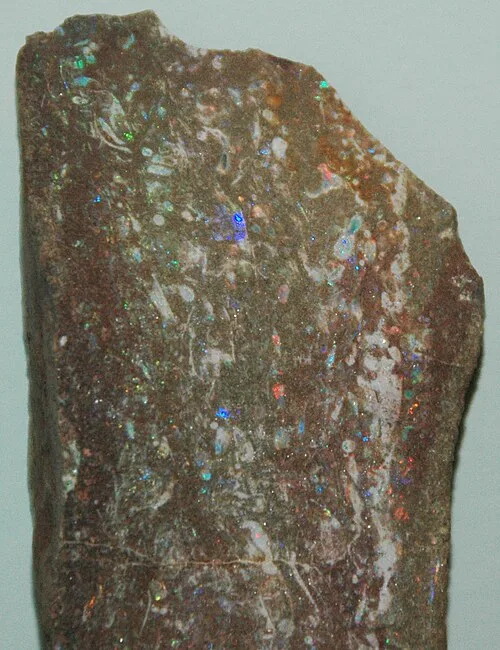
Opal · SiO₂·nH₂O. Colors: white, gray or black body with play-of-color.
- Mohs
- 5–6.5
- RI
- 1.37–1.47
- SG
- 1.25–2.23
- Crystal system
- amorphous
Precious opal at a glance.
- Species
- Opal
- Formula
- SiO₂·nH₂O
- Crystal system
- amorphous
- Mohs
- 5–6.5
- RI
- 1.37–1.47
- SG
- 1.25–2.23
- Colors
- white, gray or black body with play-of-color
What the encyclopedia says.
8 passages, quoted as published. Each links to the full entry and the sources of its chapter.
Opal
Precious opal shows play-of-color, flashes of spectral color that shift as the stone moves. The cause is diffraction: opal is built of sub-microscopic silica spheres stacked in a regular grid, and sphere size decides which colors appear, with spheres about 0.1 micrometre across giving violet and about 0.2 micrometre giving red. Common opal lacks the ordered stacking and shows no play-of-color.
Read the full entryOpal
Trade names mostly describe body color and host rock. Black opal, the rarest of the main types, has a dark body tone that makes the colors stand out. White or light opal has a pale body color and is more common. Boulder opal is cut with its ironstone matrix attached, which becomes part of the finished gem. Fire opal is transparent to translucent with a yellow, orange or red body color, with or without play-of-color, and is also called Mexican opal. Australia has been the primary source since its mines began producing commercially in the 1890s.
Read the full entrySedimentary deposits: Australian opal
Australia’s precious opal fields lie in and along the margin of the Great Artesian Basin, whose Cretaceous rocks were laid down in and beside a shallow inland sea, the Eromanga Sea. Coober Pedy and Andamooka in South Australia, White Cliffs and Lightning Ridge in New South Wales and the boulder opal fields of Queensland all sit in these sediments, and opal is recovered mainly from their Cretaceous sandstone and claystone units.
Read the full entrySedimentary deposits: Australian opal
Deposit styles differ by field. At Lightning Ridge, black opal occurs as nodules in whitish clay of the Early Cretaceous Finch Claystone; miners call them nobbies, and the deposits are usually less than 30 m below the surface. Much of a nobby is dark gray potch, with precious opal in part of it, and that dark background is what gives fine black opal its play-of-color. In Queensland, opal fills siliceous ironstone concretions that miners call lily pads or nuts, in the Desert Sandstone of Upper Cretaceous age. Opal has also replaced Cretaceous fossils, from microscopic organisms to dinosaur skeletons.
Read the full entryTanzanite, tourmaline, jade, lapis, turquoise, opal
Hpakant in Myanmar’s Kachin State is the principal source of jadeite. Loosely regulated mining there is deadly: a landslide of mine waste on 2 July 2020 killed more than 160 people. The Sar-e-Sang mines in Badakhshan, Afghanistan, supplied the ancient world with lapis lazuli, including stone found in Tutankhamun’s tomb. Turquoise has been mined for thousands of years in the hills about 50 km northwest of Nishapur in northeastern Iran. Australia dominates precious opal: black opal comes from Lightning Ridge in New South Wales, where the first shafts were sunk in 1905, and light opal from Coober Pedy in South Australia, where opal was found in 1915.
Read the full entryStabilization and impregnation of turquoise and opal
Opal is treated for other reasons. The LMHC defines hydrophane opal as opal that absorbs liquid to the point of changing its appearance and possibly its weight, and warns that the immersion test can itself crack a stone. GIA has documented oil and Opticon forced into hydrophane opal under vacuum at about 80 °C. In the sugar and acid treatment, applied to porous Andamooka matrix opal from Australia, a hot sugar bath followed by acid deposits carbon in the pores, darkening the background so the play-of-color stands out. Smoke treatment darkens hydrophane opal from Wollo, Ethiopia, and GIA documented it in 2011.
Read the full entryComposites: doublets and triplets
Assembled stones are not always imitations. Precious opal often forms in layers too thin to set, so an opal doublet bonds a slice to a dark backing of onyx, plastic or natural matrix, and an opal triplet adds a clear dome of rock crystal, glass, plastic or synthetic corundum that protects the thin opal and magnifies its color. Other types are meant to deceive. Garnet-topped doublets fuse a thin slice of red garnet to a colored glass base, giving the crown the harder, more lustrous surface and the inclusions of a natural stone. Sapphire doublets pair a natural crown with a synthetic pavilion.
Read the full entryLa Peregrina and the Olympic Australis
The Olympic Australis is the opposite case, because its owner publishes what it knows. Altmann and Cherny record a mass of precious opal of 17,000 carats, mined at the Eight Mile opal field near Coober Pedy, South Australia, in 1956. John Altmann and Rudi Cherny bought it and named it for the Olympic Games held in Melbourne that year. It is on permanent display at their showroom in Pitt Street, Sydney. The firm estimates that, cut into one-carat stones, the material would be worth about US$1.8 million.
Read the full entry
Where it is mined.
Localities from the mine map in Chapter 05.
| Locality | Country | Status | Note |
|---|---|---|---|
| Coober Pedy | Australia | artisanal | South Australia; opal found in 1915, more than 70 opal fields |
| Lightning Ridge | Australia | artisanal | New South Wales black opal field; first shafts sunk in 1905 |
| Wegel Tena (Wollo) | Ethiopia | artisanal | Precious opal found in 2008 in volcanic rock at about 3,000 m, worked from hand-dug tunnels by crews of 10 to 20 miners |
Cleaning and wear.
From the care table in Chapter 22.
| Stone | Ultrasonic | Steam | Notes |
|---|---|---|---|
| Opal | Avoid | Avoid | Warm soapy water is the only safe method; heat or sudden temperature change can cause crazing or fractures. |
Print the care chart for all 25 stones A4 · PDF · 133 kBUS Letter · PDF · 132 kB
Stones with a name.
| Name | Type | Carats | Origin | Where now |
|---|---|---|---|---|
| Olympic Australis | Precious opal | 17000 | Eight Mile field, Coober Pedy, South Australia, 1956 | Altmann and Cherny showroom, Pitt Street, Sydney |
Seen the one
you want?
Name it in a brief. We find it in any producing country and have it tested independently.