Aquamarine
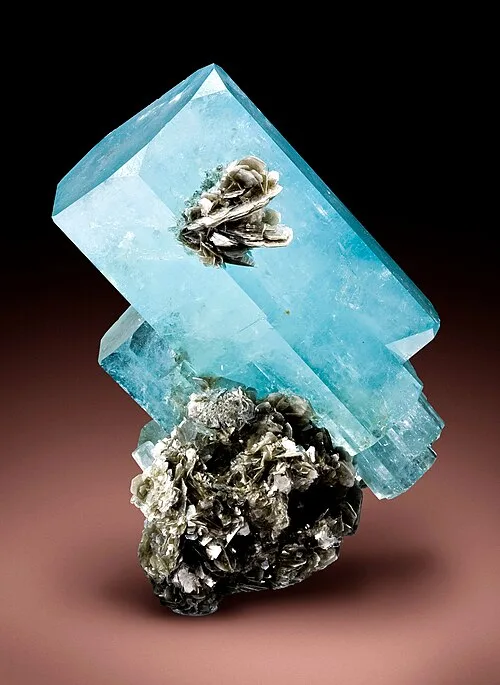
Beryl · Be₃Al₂Si₆O₁₈. Colors: greenish blue, light in tone.
- Mohs
- 7.5–8
- RI
- 1.577–1.583
- SG
- 2.72
- Crystal system
- hexagonal
Aquamarine at a glance.
- Species
- Beryl
- Formula
- Be₃Al₂Si₆O₁₈
- Crystal system
- hexagonal
- Mohs
- 7.5–8
- RI
- 1.577–1.583
- SG
- 2.72
- Colors
- greenish blue, light in tone
What the encyclopedia says.
7 passages, quoted as published. Each links to the full entry and the sources of its chapter.
The Big Four
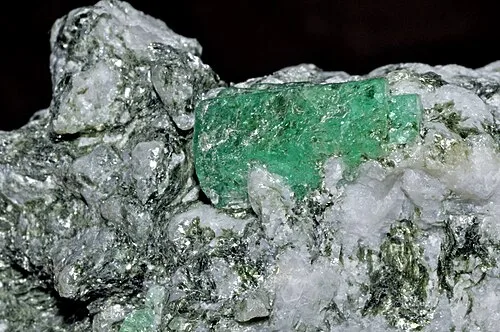
Mineralogically the group is smaller than it sounds. Ruby and sapphire are both corundum, aluminum oxide, and differ only in the trace elements that color them. Chromium makes ruby red, while iron and titanium make sapphire blue. Emerald is a green variety of beryl, the same species that produces aquamarine. Diamond stands apart as the only gem made of a single element, carbon.
Read the full entrySpecies, varieties and groups
Corundum shows how this works. Every ruby and every sapphire is crystalline aluminum oxide, Al₂O₃, with the same hardness and nearly the same density and refractive index. Traces of chromium produce red, which the trade calls ruby. Iron and titanium produce blue sapphire, and other traces give the yellow, pink, orange and violet stones sold as fancy sapphires. Beryl follows the same pattern: chromium or vanadium makes emerald, ferrous iron makes aquamarine and manganese makes morganite.
Read the full entryBeryl: emerald, aquamarine and relatives
Aquamarine is greenish blue and light in tone. Morganite, pink to orange-pink, takes its color from traces of manganese and reads a little higher, 1.583–1.590 and 2.80–2.91. Red beryl owes its color to Mn³⁺. It was first reported from Utah's Thomas Range in 1905 and found on the eastern flank of the Wah Wah Mountains in the late 1950s, still the source of nearly all gem material. Its early name bixbite never came into wide use.
Read the full entryTanzanite, tourmaline, jade, lapis, turquoise, opal
Minas Gerais in Brazil yields aquamarine, topaz and tourmaline in almost every color from granitic pegmatites, and Teófilo Otoni is its main gem-trading city. Copper-bearing “Paraíba” tourmaline, a vivid blue to green, reached the international gem market in 1989 from São José da Batalha in Paraíba state; similar material later came from Rio Grande do Norte, Nigeria and Mozambique.
Read the full entryStep, mixed and fantasy cuts; cabochons
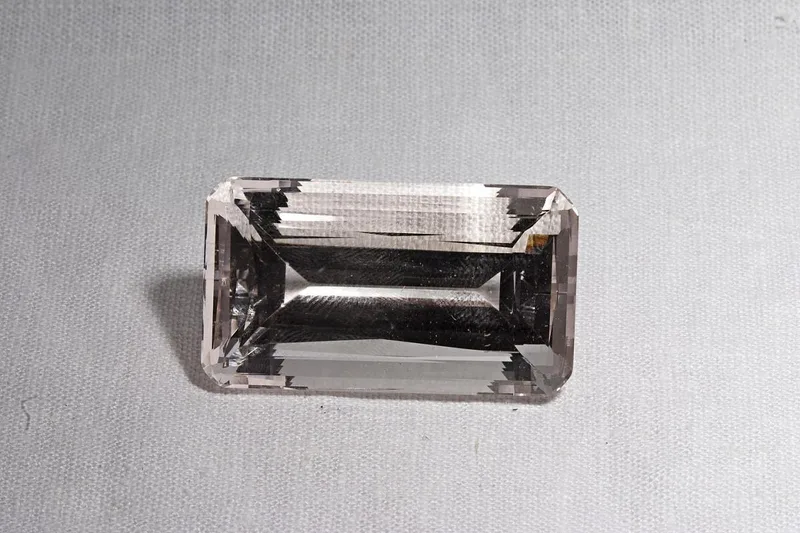
Bernd Munsteiner, born in 1943 and working at Idar-Oberstein, invented the fantasy cut: grooves, optic dishes and concave facets ground into the back of a stone. GIA dates its appearance to the 1960s. His Dom Pedro aquamarine of 1993, 10,363 ct, is at the Smithsonian. Precision cutting means faceting to angles modeled in software beforehand rather than following the rough.
Read the full entryEvaluating colored stones
Clarity is judged against what each species normally shows. GIA notes that some gem materials are almost always included while others are commonly eye-clean. Most faceted aquamarine is eye-clean. Inclusion-free rubies are practically nonexistent. Pink and red tourmaline often carries eye-visible inclusions that dealers accept when the color is strong, while green tourmaline is expected to look clean. Emerald usually shows a visible garden of inclusions, the jardin.
Read the full entryHeat treatment and the no-heat premium
Heating is the oldest and most widespread gem treatment. SSEF places commercial heating of corundum in a range of roughly 700 to 1,800 °C, dividing low-temperature work below about 1,000 °C from high-temperature work above about 1,200 °C. Past that upper figure the fine rutile needles called silk dissolve and expansion cracks open around inclusions; GIA’s 2019 Madagascar heating experiments recorded deeper, more saturated blue in stones taken that high. Heat also converts amethyst to citrine, and GIA states that most citrine sold is heated amethyst because natural citrine is rare. GIA describes aquamarine as routinely heated to remove greenish tints. LMHC Information Sheet #15 of 2025 calls tanzanite commonly heated and adds that the treatment is sometimes not determinable.
Read the full entry
Where it is mined.
Localities from the mine map in Chapter 05.
| Locality | Country | Status | Note |
|---|---|---|---|
| Teófilo Otoni district | Brazil | artisanal | Gem-trading city for the pegmatite fields of northeastern Minas Gerais |
Cleaning and wear.
From the care table in Chapter 22.
| Stone | Ultrasonic | Steam | Notes |
|---|---|---|---|
| Aquamarine | Caution | Caution | Usually safe unless the stone has liquid inclusions or fractures; rare fracture-filled stones need soapy water only. |
Print the care chart for all 25 stones A4 · PDF · 133 kBUS Letter · PDF · 132 kB
Seen the one
you want?
Name it in a brief. We find it in any producing country and have it tested independently.