Emerald
Beryl · Be₃Al₂Si₆O₁₈. Colors: green to bluish green.
- Mohs
- 7.5–8
- RI
- 1.577–1.583
- SG
- 2.72
- Crystal system
- hexagonal
Emerald at a glance.
- Species
- Beryl
- Formula
- Be₃Al₂Si₆O₁₈
- Crystal system
- hexagonal
- Mohs
- 7.5–8
- RI
- 1.577–1.583
- SG
- 2.72
- Colors
- green to bluish green
What the encyclopedia says.
8 passages, quoted as published. Each links to the full entry and the sources of its chapter.
Beryl: emerald, aquamarine and relatives
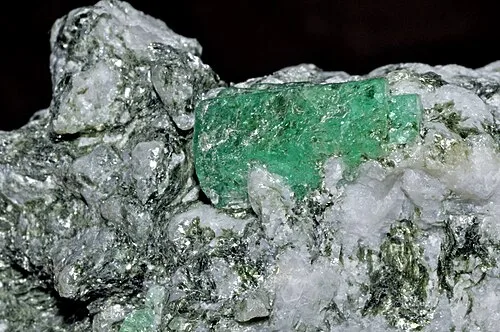
Emerald is the green to bluish green variety. Parts of the trade give the name to any green beryl colored by chromium, while most gemologists, laboratories and dealers call a stone green beryl when its color is too light for emerald. GIA settles the question against lab-graded comparison stones. Emeralds are typically included, and the trade accepts visible inclusions in emerald more readily than in most gems.
Read the full entryHydrothermal deposits: Colombian emeralds
Emerald needs beryllium, which concentrates in granites and pegmatites, together with chromium or vanadium, which concentrate in dark mafic and ultramafic rocks and in some shales. Most deposits bring the two together: GIA’s review puts the type hosted in metamorphosed mafic and ultramafic rocks at about 70% of world production, with Brazil, Zambia and Russia the main suppliers.
Read the full entryHydrothermal deposits: Colombian emeralds
Colombia’s deposits in the Eastern Cordillera formed another way, with no igneous activity involved. The emeralds occur in veins and breccias within Lower Cretaceous black shales. In a 1994 Nature paper, T. L. Ottaway and colleagues showed for the Muzo mine that hydrothermal brines carried evaporitic sulfate to favorable structures, where it was chemically reduced; the sulfur then reacted with organic matter in the shale, releasing the chromium, vanadium and beryllium trapped there. GIA puts these basinal fluids at 300–330 °C and up to 40 wt.% equivalent NaCl, formed at depth where meteoric and formational water met salt beds and evaporite sequences.
Read the full entryEmerald deposits
Colombia has set the standard for emerald since the Spanish conquest. The Muisca mined emeralds before the Spanish arrived; conquistadors reached Chivor in 1537 and the Muzo area in the 1540s. Muzo, Coscuez and Chivor, all in Boyacá, remain the main districts. Colombia supplied about 47% of world emerald output in the decade to 2005, a share that has since declined.
Read the full entryEmerald deposits
Zambia ranks second. Kagem, an open pit in the Ndola Rural Emerald Restricted Area of the Copperbelt, is owned 75% by Gemfields and 25% by the state Industrial Development Corporation, and Gemfields calls it the world’s largest producing emerald mine. Gemfields decided at the end of 2024 to pause mining from 1 January 2025 in an oversupplied emerald market. Zambia suspended its 15% export duty on 18 February 2025, restarting exports, and mining resumed in May 2025. It yielded an 11,685 ct crystal, named Imboo, in 2025. Gemfields has sold Kagem rough through its own auctions since 2009.
Read the full entryOiling and resin filling in emeralds
Almost every emerald has fissures reaching the surface, and filling them with a colorless substance of similar refractive index makes them far less visible. Cedarwood oil and Canada balsam are the traditional fillers; GIA’s 1991 survey of Brazilian practice found the epoxy resin sold as Opticon in routine use after cutting, and its 1999 study sorted 39 filling substances into oils, waxes, prepolymers and polymers. GIA’s buying guide states that most emeralds are treated with oil, resin or polymer.
Read the full entryOiling and resin filling in emeralds
The fillers are not permanent. GIA’s 2007 durability study found changes in about 35 percent of filled emeralds after mild exposure to ultraviolet light, display heat, chill-thaw cycles and drying, and concluded that none of the fillers tested survived every test. Ultrasonic cleaning, ethanol and acetone did most damage to liquid-filled stones.
Read the full entryMuseum sapphires, rubies and emeralds
The Star of India, a Sri Lankan star sapphire of just over 563 carats, is the largest gem-quality star sapphire known. Its six-rayed star, or asterism, comes from light reflecting off needles of rutile, which the American Museum of Natural History describes as a flaw rather than a virtue. On 29 October 1964 Jack Murphy and two accomplices took it from the museum’s old Morgan Memorial Hall along with the DeLong Star Ruby, the Midnight Star, the Schettler Emerald and nearly all the diamonds. Arrests came quickly and most of the notable stones returned. The DeLong Star Ruby had to be ransomed. About a dozen stones never came back, and they included every diamond.
Read the full entry
Where it is mined.
Localities from the mine map in Chapter 05.
| Locality | Country | Status | Note |
|---|---|---|---|
| Panjshir Valley (Khenj) | Afghanistan | artisanal | Informal mines at about 2,100–4,400 m; the village of Khenj lies about 113 km northeast of Kabul |
| Belmont | Brazil | active | Open pit and underground mine 13 km southeast of Itabira, worked since 1978; the largest colored-stone operation in Minas Gerais |
| Chivor | Colombia | active | Reached by the Spanish in 1537, abandoned, and reopened in the late 19th century |
| Coscuez | Colombia | active | Emerald district in San Pablo de Borbur municipality, western Boyacá |
| Muzo | Colombia | active | Western Boyacá; worked by the Muzo people before the Spanish, who took over from the 1540s |
| Shakiso | Ethiopia | artisanal | Emeralds mined near Kenticha reached world markets in late 2016 (point marks the trading town) |
| Swat valley (Mingora) | Pakistan | active | Emerald in talc-carbonate rock of the Indus suture; Mingora opened in 1958, with Gujar Kili now the leading producer |
| Malysheva (Mariinsky mine) | Russia | active | Mine in the Ural emerald belt at Malyshevo; emerald and alexandrite come from the same schists, worked since the 1830s |
| Kagem | Zambia | active | Open pit in the Ndola Rural Emerald Restricted Area, Copperbelt; Gemfields 75%, IDC 25% |
Cleaning and wear.
From the care table in Chapter 22.
| Stone | Ultrasonic | Steam | Notes |
|---|---|---|---|
| Emerald | Avoid | Avoid | Most emeralds are fracture-filled; vibration can worsen fractures and steam can draw out oils or resins. |
Print the care chart for all 25 stones A4 · PDF · 133 kBUS Letter · PDF · 132 kB
Stones with a name.
| Name | Type | Carats | Origin | Where now |
|---|---|---|---|---|
| Carved Mughal emerald | Carved emerald | 217.8 | India, the place of carving in the Qatar Museums record | Museum of Islamic Art, Doha |
| Chalk Emerald | Emerald | 37.8 | Colombia | Smithsonian National Museum of Natural History, Washington |
Seen the one
you want?
Name it in a brief. We find it in any producing country and have it tested independently.