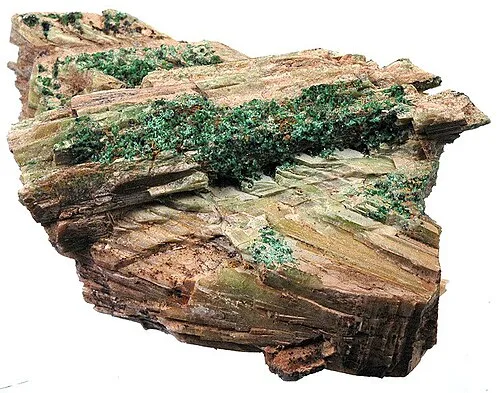
Chrome diopside
Diopside · CaMgSi₂O₆. Colors: intense green.
- Mohs
- 5.5–6.5
- RI
- 1.664–1.73
- SG
- 3.22–3.38
- Crystal system
- monoclinic
Chrome diopside at a glance.
- Species
- Diopside
- Formula
- CaMgSi₂O₆
- Crystal system
- monoclinic
- Mohs
- 5.5–6.5
- RI
- 1.664–1.73
- SG
- 3.22–3.38
- Colors
- intense green
What the encyclopedia says.
4 passages, quoted as published. Each links to the full entry and the sources of its chapter.
Turquoise, lapis lazuli, malachite and feldspars
Lapis lazuli is a rock, an aggregate of lazurite with calcite and pyrite and lesser diopside, amphibole, feldspar or mica. Lazurite gives the prized royal blue, and ground lapis supplied the ultramarine pigment of Renaissance painting.
Read the full entryApatite, sphene, andalusite, kyanite, diopside, fluorite
Diopside, CaMgSi₂O₆, is best known as the intense green chrome diopside, colored by chromium and mined in Russia. Fluorite, CaF₂, defines 4 on the Mohs scale, occurs in almost every color and splits easily along four cleavage directions, so it is cut mostly for collections.
Read the full entryExploration, sorting and recovery
Diamond explorers hunt for kimberlite indicator minerals: grains of garnet, chrome diopside and ilmenite whose chemistry shows they formed at mantle depths and which rivers or glaciers spread away from a pipe. Aeromagnetic, resistivity and gravity surveys then locate the pipe, and drilling and bulk sampling test its grade, in carats per hundred tonnes, and the value of its diamonds. In 1991 Chuck Fipke and Stewart Blusson followed an indicator-mineral trail across the Northwest Territories to the Lac de Gras pipes that became Ekati, setting off a huge staking rush.
Read the full entryDealers, auction specialists and geologists
An exploration geologist searches for new deposits. For diamonds, that means sampling soils and stream sediments for indicator minerals such as pyrope garnet, chrome diopside, ilmenite and chromite, which weather out of kimberlite pipes, then testing targets with magnetic and gravity surveys and drilling. Colored-stone exploration focuses more on mapping pegmatites, marbles and gem gravels. The role usually requires a geology degree and long periods of fieldwork in remote camps.
Read the full entry
Seen the one
you want?
Name it in a brief. We find it in any producing country and have it tested independently.