Topaz
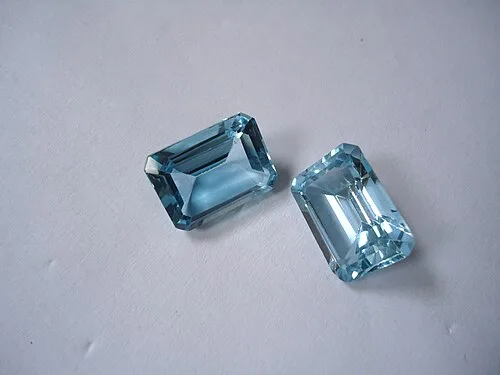
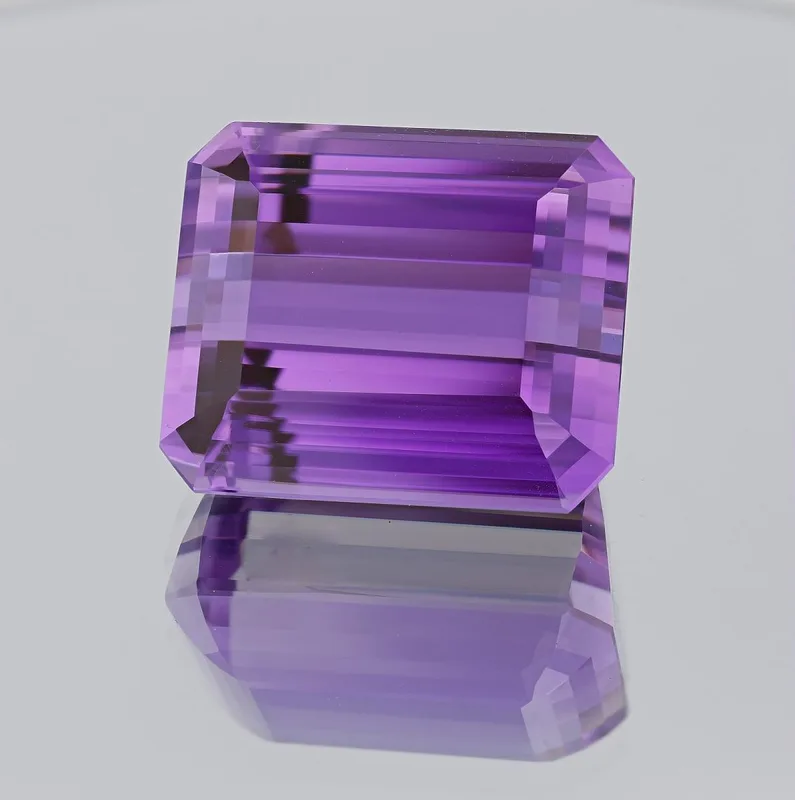
Topaz · Al₂SiO₄(F,OH)₂. Colors: yellow, orange, brown, pink to red to purple, blue, colorless.
- Mohs
- 8
- RI
- 1.619–1.627
- SG
- 3.53
- Crystal system
- orthorhombic
Topaz at a glance.
- Species
- Topaz
- Formula
- Al₂SiO₄(F,OH)₂
- Crystal system
- orthorhombic
- Mohs
- 8
- RI
- 1.619–1.627
- SG
- 3.53
- Colors
- yellow, orange, brown, pink to red to purple, blue, colorless
What the encyclopedia says.
8 passages, quoted as published. Each links to the full entry and the sources of its chapter.
Other transparent gems: tanzanite to spodumene
Topaz, Al₂SiO₄(F,OH)₂, is hard at 8 but has perfect cleavage in one direction. Its color is allochromatic: chromium accounts for natural pink, red and violet to purple, while defects in the crystal structure account for yellow, brown and blue. Most blue topaz is colorless material irradiated with electrons and then heated. Imperial topaz, a medium reddish orange to orange-red, comes commercially from one area, Ouro Preto in Brazil.
Read the full entryHardness, toughness, cleavage and stability
Toughness is resistance to breaking and chipping, and it is independent of hardness. Jadeite rates 6.5 to 7 and nephrite 6 to 6.5, yet both are extremely tough, which is why Neolithic knives and axe heads were often made of nephrite. Diamond, the hardest natural gem, can still split under a sharp blow: it has four perfect cleavage directions, parallel to its triangular octahedral faces. Topaz has one perfect cleavage, on {001}, and kunzite two. Where no cleavage exists a stone breaks by fracture; quartz and glass show curved, shell-like conchoidal fracture.
Read the full entryPegmatites
Gem crystals occur most often in open or clay-filled pockets in the core and central zones of the body, where they grew freely into fluid-filled space. Bodies with such cavities are called miarolitic pegmatites, and they sit within or near plutons that intruded to shallow depths in the crust. Pegmatites of the lithium-cesium-tantalum (LCT) family greatly outnumber those of the niobium-yttrium-fluorine (NYF) family, and they are significant producers of gem tourmaline, beryl, spodumene, topaz and garnet.
Read the full entryTanzanite, tourmaline, jade, lapis, turquoise, opal
Minas Gerais in Brazil yields aquamarine, topaz and tourmaline in almost every color from granitic pegmatites, and Teófilo Otoni is its main gem-trading city. Copper-bearing “Paraíba” tourmaline, a vivid blue to green, reached the international gem market in 1989 from São José da Batalha in Paraíba state; similar material later came from Rio Grande do Norte, Nigeria and Mozambique.
Read the full entryHPHT, irradiation and annealing
Irradiation creates color centers, lattice defects that absorb light. GIA says high-energy electrons are the most common source, and that annealing, controlled heating, often follows to shift the result. The US Nuclear Regulatory Commission calls topaz the most commonly treated stone. GIA states that blue topaz occurs in nature but is rare, and that most blue topaz on the market has been irradiated.
Read the full entryHistoric trade routes
After the Portuguese reached India in 1498, Goa became the leading gem port of Asia, and the road from Goa to Agra, 1,667 km inland, fed the Mughal court. Tavernier wrote that Goa once held the largest trade in Asia in diamonds, rubies, sapphires and topaz. The map below sets out six of these corridors.
Read the full entryGems in scripture and sacred astrology
The Book of Exodus (chapter 28) describes a breastpiece for the high priest Aaron set with twelve stones in four rows, one for each tribe of Israel. The Hebrew names are hard to match to modern minerals: the King James Version gives the first row as sardius, topaz and carbuncle. Ancient terms did not follow modern definitions: Pliny's sapphirus, an opaque azure stone refulgent with spots like gold and best from Media, is lapis lazuli with pyrite.
Read the full entryGems in scripture and sacred astrology
In Hindu astrology the navaratna, or nine gems, assigns a stone to each celestial body of the Navagraha: ruby for the Sun, pearl for the Moon, red coral for Mars, emerald for Mercury, yellow sapphire for Jupiter, diamond for Venus, blue sapphire for Saturn, hessonite for Rahu and cat's eye chrysoberyl for Ketu. The ruby sits at the center. The V&A's catalogue groups five maharatnani (diamond, pearl, ruby, sapphire, emerald) and four uparatnani (jacinth, topaz, cat's eye, coral), though these may vary. Astrological gem prescriptions are cultural and religious beliefs; no controlled study shows a stone changes its wearer's fortune.
Read the full entry
Where it is mined.
Localities from the mine map in Chapter 05.
| Locality | Country | Status | Note |
|---|---|---|---|
| Capão mine (Ouro Preto) | Brazil | active | Minas Gerais; mechanised mine 3 km west of Rodrigo Silva, in the Ouro Preto district, the only known source of imperial topaz since the 1700s |
| Teófilo Otoni district | Brazil | artisanal | Gem-trading city for the pegmatite fields of northeastern Minas Gerais |
Cleaning and wear.
From the care table in Chapter 22.
| Stone | Ultrasonic | Steam | Notes |
|---|---|---|---|
| Topaz | Avoid | Avoid | Basal cleavage makes it prone to splitting; sharp temperature changes can break it. Coated topaz needs gentle cleaning. |
Print the care chart for all 25 stones A4 · PDF · 133 kBUS Letter · PDF · 132 kB
Seen the one
you want?
Name it in a brief. We find it in any producing country and have it tested independently.