Zircon
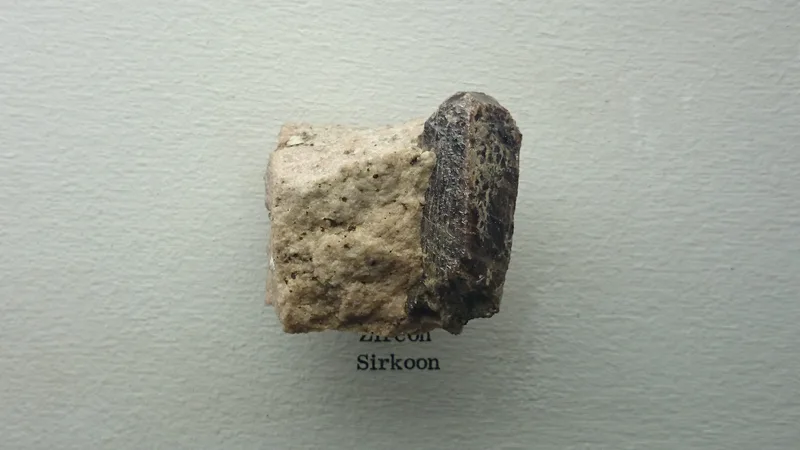
Zircon · ZrSiO₄. Colors: blue, red, yellow, orange, brown, green.
- Mohs
- 6–7.5
- RI
- 1.81–1.984
- SG
- 3.9–4.73
- Crystal system
- tetragonal
Zircon at a glance.
- Species
- Zircon
- Formula
- ZrSiO₄
- Crystal system
- tetragonal
- Mohs
- 6–7.5
- RI
- 1.81–1.984
- SG
- 3.9–4.73
- Colors
- blue, red, yellow, orange, brown, green
What the encyclopedia says.
5 passages, quoted as published. Each links to the full entry and the sources of its chapter.
Other transparent gems: tanzanite to spodumene
Zircon, ZrSiO₄, is a natural mineral, unrelated to synthetic cubic zirconia. Uranium and thorium damage the lattice over geologic time, giving low zircon much lower optical and physical properties; heating to high temperatures repairs some of that damage, and nearly all jewelry zircon is of the high type.
Read the full entrySimulants
Older simulants survive in vintage jewelry. Synthetic rutile reached the market in 1948, strontium titanate in 1955, YAG in 1968 and gadolinium gallium garnet (GGG) in 1975. GIA also lists glass and colorless zircon among the materials sold to stand in for diamond.
Read the full entryRefractometer, polariscope and dichroscope
The refractometer measures refractive index (RI) by critical angle. A flat facet rests on a dense glass hemicylinder, joined by a drop of contact liquid; the boundary between light and dark on the internal scale marks the stone's RI, read under yellow light. A doubly refractive stone gives two readings as it is turned; their difference is the birefringence, and the way they move shows whether the stone is uniaxial or biaxial. Curved cabochons give a blurred spot reading instead. GIA's contact liquid has an RI of 1.81, and nothing above it can be read, so demantoid, high zircon, cubic zirconia, diamond and garnet at the top of its range show no edge and are recorded as over the limit.
Read the full entrySpectroscope, Chelsea filter, UV lamps and SG balance
The hand spectroscope spreads light that has passed through a gem into a spectrum, where absorbed wavelengths appear as dark lines and bands. Prism models stretch the blue end; diffraction-grating models spread the visible range more evenly. Several patterns are diagnostic: chromium gives ruby a narrow line at 694 nm, iron in corundum produces features near 377, 388 and 450 nm once the iron content passes about 150 ppma, and zircon shows a series of lines gemologists call the organ-pipe spectrum. GIA calls the hand spectroscope one of the hardest portable instruments to master.
Read the full entryTrace-element geochemistry and origin
Inclusions add a time dimension. SSEF's GemTOF, a time-of-flight LA-ICP-MS installed in July 2016, records nearly the whole periodic table at once and can date zircon inclusions by uranium and lead. Raman spectra of those inclusions help as well: zircons in geologically young Kashmir sapphires give narrow peaks, while the older, more metamict zircons in Madagascar sapphires give broad bands.
Read the full entry
Cleaning and wear.
From the care table in Chapter 22.
| Stone | Ultrasonic | Steam | Notes |
|---|---|---|---|
| Zircon | Avoid | Avoid | More brittle than sapphire; heat can alter color, and some heat-treated stones revert in bright light. |
Print the care chart for all 25 stones A4 · PDF · 133 kBUS Letter · PDF · 132 kB
Seen the one
you want?
Name it in a brief. We find it in any producing country and have it tested independently.