Lapis lazuli
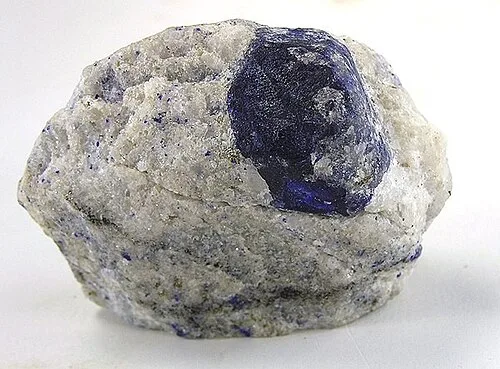
Rock (lazurite, calcite, pyrite) · Lazurite: Na₇Ca(Al₆Si₆O₂₄)(SO₄)(S₃)⁻·H₂O. Colors: greenish blue to violetish blue, with calcite and pyrite.
- Mohs
- 5–6
- RI
- 1.5–1.67
- SG
- 2.5–3
- Crystal system
- rock (lazurite cubic)
Lapis lazuli at a glance.
- Species
- Rock (lazurite, calcite, pyrite)
- Formula
- Lazurite: Na₇Ca(Al₆Si₆O₂₄)(SO₄)(S₃)⁻·H₂O
- Crystal system
- rock (lazurite cubic)
- Mohs
- 5–6
- RI
- 1.5–1.67
- SG
- 2.5–3
- Colors
- greenish blue to violetish blue, with calcite and pyrite
What the encyclopedia says.
8 passages, quoted as published. Each links to the full entry and the sources of its chapter.
Minerals, rocks, organic gems and man-made stones
Several important gems do not. A rock is an aggregate of one or more minerals: lapis lazuli is a rock made mostly of blue lazurite with white calcite and brassy pyrite. A mineraloid is natural but lacks an ordered structure, and opal and obsidian are the usual examples. Organic gems come from living things. Pearl grows inside mollusks, precious coral is an animal skeleton, amber is fossilized tree resin and jet is a type of lignite formed from ancient wood.
Read the full entryTurquoise, lapis lazuli, malachite and feldspars
Lapis lazuli is a rock, an aggregate of lazurite with calcite and pyrite and lesser diopside, amphibole, feldspar or mica. Lazurite gives the prized royal blue, and ground lapis supplied the ultramarine pigment of Renaissance painting.
Read the full entryTanzanite, tourmaline, jade, lapis, turquoise, opal
Hpakant in Myanmar’s Kachin State is the principal source of jadeite. Loosely regulated mining there is deadly: a landslide of mine waste on 2 July 2020 killed more than 160 people. The Sar-e-Sang mines in Badakhshan, Afghanistan, supplied the ancient world with lapis lazuli, including stone found in Tutankhamun’s tomb. Turquoise has been mined for thousands of years in the hills about 50 km northwest of Nishapur in northeastern Iran. Australia dominates precious opal: black opal comes from Lightning Ridge in New South Wales, where the first shafts were sunk in 1905, and light opal from Coober Pedy in South Australia, where opal was found in 1915.
Read the full entryCoating, dyeing and bleaching
Dyeing needs somewhere for color to go. Gem-A notes that stones are soaked in pigment solutions, sometimes after heating or chemical attack has opened fractures and pore spaces, and lists jadeite, opal, lapis lazuli, pearls, corundum and quartz among commonly dyed materials, along with quartzite, magnesite and marble used as simulants. Idar-Oberstein has colored agate by inorganic chemistry for generations, and a sugar route makes black agate. Dye concentrates in cracks and pores, and an acetone swab can pick up the color.
Read the full entryHistoric trade routes
Gems traveled farther than almost any other goods because they packed great value into little weight. Lapis lazuli from Badakhshan in northeast Afghanistan reached Mesopotamia by about 3500 BCE; Georgina Herrmann's study of the early trade names Badakhshan as the only probable source of the lapis found in Mesopotamian graves, some 1,500 miles away across desert and mountain. The overland networks later called the Silk Road took shape between the 2nd century BCE and the 1st century CE and stayed in use until the 16th century, linking Chang'an and Luoyang to Central Asia.
Read the full entryGems in scripture and sacred astrology
The Book of Exodus (chapter 28) describes a breastpiece for the high priest Aaron set with twelve stones in four rows, one for each tribe of Israel. The Hebrew names are hard to match to modern minerals: the King James Version gives the first row as sardius, topaz and carbuncle. Ancient terms did not follow modern definitions: Pliny's sapphirus, an opaque azure stone refulgent with spots like gold and best from Media, is lapis lazuli with pyrite.
Read the full entryMourning jewelry, talismans and amulets
Amulets are among the oldest uses of gems. Ancient Egyptians wore and buried protective charms of carnelian, lapis lazuli and turquoise, including scarabs and the eye of Horus. Pliny the Elder recorded with derision the claim of the Magi that amethyst kept its wearer from drunkenness; he traced the name instead to the stone's color, close to wine and then fading into violet. Protective traditions continue in evil-eye charms and navaratna jewelry; there is no evidence that stones protect their wearers.
Read the full entryMughal, Renaissance and Imperial Russian jewelry
In Renaissance and early 17th-century Europe, goldsmiths made enameled pendants, hat badges and cameos for courts that treated jewelry as display. The Cheapside Hoard, about 500 jewels and gems found near St Paul's in June 1912 and probably buried around 1640, shows how far that trade reached. It holds Colombian emeralds, Indian rubies and diamonds, Persian turquoise and Afghan lapis lazuli, and a gold watch inside a hollowed emerald. Most is at the London Museum, with 25 at the British Museum and five at the V&A.
Read the full entry
Where it is mined.
Localities from the mine map in Chapter 05.
| Locality | Country | Status | Note |
|---|---|---|---|
| Sar-e-Sang | Afghanistan | active | Kokcha valley, Badakhshan; lapis source of the ancient world |
Cleaning and wear.
From the care table in Chapter 22.
| Stone | Ultrasonic | Steam | Notes |
|---|---|---|---|
| Lapis lazuli | Avoid | Avoid | GIA's 4Cs cleaning guidance lists lapis among heat-sensitive stones not to be cleaned ultrasonically; warm soapy water, testing dyed stones first. |
Print the care chart for all 25 stones A4 · PDF · 133 kBUS Letter · PDF · 132 kB
Seen the one
you want?
Name it in a brief. We find it in any producing country and have it tested independently.