Turquoise
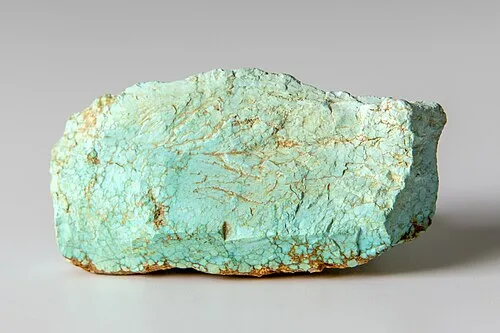
Turquoise · CuAl₆(PO₄)₄(OH)₈·4H₂O. Colors: blue to green.
- Mohs
- 5–6
- RI
- 1.61–1.65
- SG
- 2.4–2.9
- Crystal system
- triclinic
Turquoise at a glance.
- Species
- Turquoise
- Formula
- CuAl₆(PO₄)₄(OH)₈·4H₂O
- Crystal system
- triclinic
- Mohs
- 5–6
- RI
- 1.61–1.65
- SG
- 2.4–2.9
- Colors
- blue to green
What the encyclopedia says.
8 passages, quoted as published. Each links to the full entry and the sources of its chapter.
Turquoise, lapis lazuli, malachite and feldspars
Turquoise is a hydrated copper aluminum phosphate, CuAl₆(PO₄)₄(OH)₈·4H₂O, with a hardness of 5–6, a refractive index of 1.610–1.650 and a specific gravity near 2.76. It forms in dry, barren country where acidic, copper-rich groundwater seeps down and reacts with minerals containing phosphorus and aluminum, leaving a porous, semitranslucent to opaque material. Deposits sit in iron-rich limonite or sandstone, whose remnants show as the dark or tan veining called matrix. The Nishapur district of Iran set the traditional standard for sky blue, and the trade calls that color Persian blue whatever the origin. CIBJO records plastic impregnation and near-colorless surface waxing as treatments commonly applied to turquoise.
Read the full entryLuster, transparency and pleochroism
Luster describes the quality of light reflected from a gem’s surface. It depends on refractive index and on how well the surface takes a polish. Diamond has adamantine luster, the brightest ordinary type; most gems, from quartz to corundum, are vitreous, or glassy. Other standard terms include resinous for amber, waxy for turquoise, pearly for pearls and some cleavage surfaces, and silky for fibrous materials.
Read the full entryColor: hue, tone, saturation and chromophores
Color arises when a gem absorbs some visible wavelengths and transmits or reflects the rest. In idiochromatic gems the coloring element is a major ingredient, as with copper in turquoise and malachite. Most gems are allochromatic: colorless when pure and colored by trace chromophores. GIA’s survey of corundum lists six of them, including Cr³⁺, Fe³⁺, V³⁺, the Fe²⁺ to Ti⁴⁺ pair and two trapped-hole pairs that give orange and yellow. Red in ruby takes several hundred to a few thousand parts per million of Cr³⁺; blue sapphire comes from intervalence charge transfer, an electron moving from Fe²⁺ to Ti⁴⁺ under light and back again.
Read the full entryTanzanite, tourmaline, jade, lapis, turquoise, opal
Hpakant in Myanmar’s Kachin State is the principal source of jadeite. Loosely regulated mining there is deadly: a landslide of mine waste on 2 July 2020 killed more than 160 people. The Sar-e-Sang mines in Badakhshan, Afghanistan, supplied the ancient world with lapis lazuli, including stone found in Tutankhamun’s tomb. Turquoise has been mined for thousands of years in the hills about 50 km northwest of Nishapur in northeastern Iran. Australia dominates precious opal: black opal comes from Lightning Ridge in New South Wales, where the first shafts were sunk in 1905, and light opal from Coober Pedy in South Australia, where opal was found in 1915.
Read the full entryStabilization and impregnation of turquoise and opal
Porous gems that would otherwise absorb skin oils or look chalky are often filled. Waxing and oiling are long-standing surface treatments that improve durability and appearance. Stabilization goes further: resin is forced into the pores under vacuum and pressure. GIA’s 2021 study of resin-filled turquoise measured surface porosity falling from about 1.9 percent to 0.7 percent, with color improving because less light scatters, and identified the resin by an infrared band near 1730 cm⁻¹ and by strong blue fluorescence under long-wave ultraviolet. A separate proprietary process, developed in the late 1980s by the electrical engineer James E. Zachery, cuts porosity and improves polish while leaving standard gemological properties much as they were; GIA reported in 1999 that more than 10 million carats had been treated and that treated stones carry significantly more potassium, detectable by EDXRF.
Read the full entryHistoric trade routes
India supplied the world's diamonds until Brazilian deposits were found in the early 18th century. The French merchant Jean-Baptiste Tavernier made six journeys between 1630 and 1668 and described four mines around Golconda: Rammalakota, Kollur, Soumelpour in Bengal and Kistna. Ceylon (Sri Lanka) and Pegu in Burma shipped rubies, sapphires and rock crystal; Badakhshan sent spinel, Persia turquoise, and Colombia emeralds carried east through European hands.
Read the full entryMourning jewelry, talismans and amulets
Amulets are among the oldest uses of gems. Ancient Egyptians wore and buried protective charms of carnelian, lapis lazuli and turquoise, including scarabs and the eye of Horus. Pliny the Elder recorded with derision the claim of the Magi that amethyst kept its wearer from drunkenness; he traced the name instead to the stone's color, close to wine and then fading into violet. Protective traditions continue in evil-eye charms and navaratna jewelry; there is no evidence that stones protect their wearers.
Read the full entryMughal, Renaissance and Imperial Russian jewelry
In Renaissance and early 17th-century Europe, goldsmiths made enameled pendants, hat badges and cameos for courts that treated jewelry as display. The Cheapside Hoard, about 500 jewels and gems found near St Paul's in June 1912 and probably buried around 1640, shows how far that trade reached. It holds Colombian emeralds, Indian rubies and diamonds, Persian turquoise and Afghan lapis lazuli, and a gold watch inside a hollowed emerald. Most is at the London Museum, with 25 at the British Museum and five at the V&A.
Read the full entry
Where it is mined.
Localities from the mine map in Chapter 05.
| Locality | Country | Status | Note |
|---|---|---|---|
| Nishapur turquoise mines | Iran | active | Ancient mines at Ma’dan, about 50 km northwest of Nishapur, still worked |
Cleaning and wear.
From the care table in Chapter 22.
| Stone | Ultrasonic | Steam | Notes |
|---|---|---|---|
| Turquoise | Avoid | Avoid | Never steam or ultrasonic; heat and solvents damage treated surfaces, and skin oils and cosmetics discolor it. |
Print the care chart for all 25 stones A4 · PDF · 133 kBUS Letter · PDF · 132 kB
Seen the one
you want?
Name it in a brief. We find it in any producing country and have it tested independently.