Pearl
Nacre (calcium carbonate) · CaCO₃. Colors: white, black, gray, yellow, orange, pink, lavender, green, blue.
- Mohs
- 2.5–3
- RI
- 1.52–1.69
- SG
- 2.6–2.85
- Crystal system
- organic
Pearl at a glance.
- Species
- Nacre (calcium carbonate)
- Formula
- CaCO₃
- Crystal system
- organic
- Mohs
- 2.5–3
- RI
- 1.52–1.69
- SG
- 2.6–2.85
- Colors
- white, black, gray, yellow, orange, pink, lavender, green, blue
What the encyclopedia says.
8 passages, quoted as published. Each links to the full entry and the sources of its chapter.
Pearls
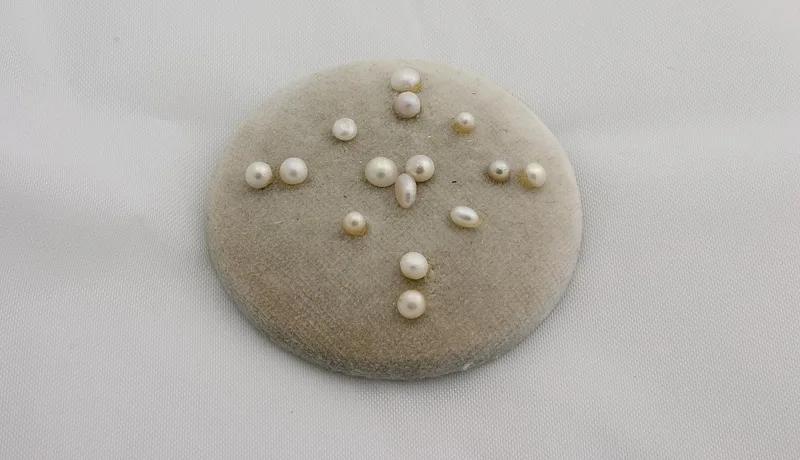
A pearl forms when a mollusk coats an irritant with nacre. GIA gives pearl a composition of calcium carbonate, a hardness of 2.5–3, a refractive index of 1.52–1.69 and a specific gravity of 2.60–2.85. Light interacting with the thin nacre layers produces luster and the iridescence called orient. Natural pearls grow in the body or mantle tissue of certain mollusks, usually around a microscopic irritant, without human help of any kind. Cultured pearls grow after a technician inserts a shell bead together with a piece of mantle tissue into a host mollusk's gonad, or mantle tissue alone into its mantle.
Read the full entryPearls
The trade recognizes four main cultured types. Akoya pearls, mostly white or cream, come from Pinctada fucata oysters farmed in Japan and China. South Sea pearls, from Pinctada maxima of Australia, Indonesia and the Philippines, are white to silver or golden, large and thick-nacred. Tahitian pearls, from Pinctada margaritifera around French Polynesia, may be gray, black or brown with green, blue, purple or pink overtones. Freshwater pearls, cultured mainly in China, are the most abundant and come in the widest range of sizes, shapes and colors. Not all pearls are nacreous. Conch pearls, from the queen conch, have a porcelain-like surface with a flame structure and occur in about one conch in ten to fifteen thousand; they were first cultured at Florida Atlantic University in 2009, with small-scale commercial production since. Orange melo pearls are also non-nacreous.
Read the full entryPearl grading
Nacre is the layered material a mollusk lays down around a nucleus or irritant. The CIBJO Pearl Book describes it as microscopic platelets of biomineralized aragonite bound by conchiolin, a scleroprotein. In beaded cultured pearls the nacre must be thick enough for good luster and durability; thin nacre looks dull or chalky and lets the bead show. Color combines the bodycolor with any overtone and with orient, an iridescent shimmer at or just below the surface. Size is given as measurements in millimeters rather than a single diameter, since a baroque pearl has none. GIA publishes 2.00 to 11.00 mm for akoya, 4.00 to 16.00 for freshwater, 9.00 to 14.00 for Tahitian and 8.00 to 20.00 for South Sea pearls.
Read the full entryPearl grading
Many sellers use letter scales such as AAA to A. Neither GIA nor the CIBJO Pearl Book defines them. Separating natural from cultured pearls is laboratory work: GIA calls microradiography the most reliable non-destructive way to see a pearl's internal structure.
Read the full entryDisclosure standards: CIBJO Blue Books and the FTC
Two codes set out what sellers must say about treatments. The CIBJO Blue Books, published by the World Jewellery Confederation, cover diamonds, colored gemstones, pearls, coral, precious metals, gemological laboratories and responsible sourcing. CIBJO calls them living documents reviewed annually and presents them as filling the near absence of ISO standards for the trade; it also records that a Munich court relied on them in 2004 when it stopped a seller using the term cultured diamonds. The Gemstone Book of December 2022 defines a treatment as a practice that artificially changes a gem’s appearance or durability, requires disclosure before the sale is completed and on invoices and in advertising, and sets codes including O for oil-filled, RES for resin-filled and F for fracture or glass filled. The 2024 Pearl Book lists bleaching, dyeing, irradiation, filling, coating, oiling, waxing and luster treatment among treatments that must be disclosed.
Read the full entryLaboratory spectroscopy, chemistry and imaging
For chemistry, EDXRF (energy-dispersive X-ray fluorescence) reads the characteristic X-rays of each element but cannot detect anything lighter than sodium, so it misses beryllium in corundum. LA-ICP-MS (laser ablation inductively coupled plasma mass spectrometry) vaporizes a speck, leaving a crater about 50 µm across, usually on the girdle, and measures most trace elements below 1 ppm and heavy elements to parts per billion. For pearls, X-ray radiography and micro-CT image internal structure, though mounted pearls generally have to be removed first.
Read the full entryLa Peregrina and the Olympic Australis
La Peregrina is a large natural pear-shaped pearl about which institutions say very little. No grade-A source consulted carries its pre-20th-century provenance, its grain weights or the December 2011 auction result. The familiar story, that Spanish queens wore it, that Joseph Bonaparte carried it out of Spain in 1813, that it passed to the Hamilton family, comes from popular retellings rather than from a holding institution, and the pearl is now in a private collection. Pearls are weighed in grains, four to the carat, and the grain figures quoted for La Peregrina come from the same retellings.
Read the full entryCrown jewels
Historic Royal Palaces counts more than 100 objects and over 23,000 gemstones in the Crown Jewels at the Tower of London, and the Royal Collection records the Imperial State Crown as set with 2,868 diamonds, 17 sapphires, 11 emeralds and 269 pearls. Iran’s national jewels sit in the Treasury of the Central Bank in Tehran, which describes the Darya-i-Noor as the largest pink diamond in the world at about 182 ct, set in a frame of 457 diamonds and four rubies, and a Pahlavi crown of 3,380 diamonds and 368 pearls weighing 2,080 g. Russia’s Diamond Fund holds the Great Imperial Crown, made for Catherine II in 1762 with 4,936 diamonds totaling 2,858 ct, 75 Indian pearls and a 398.72 ct spinel. The Munich Residenz Treasury holds the Bavarian regalia, whose crown Martin-Guillaume Biennais made in Paris in 1806. Portugal’s Museu do Tesouro Real opened in the west wing of the Ajuda National Palace on 1 June 2022 with more than a thousand pieces.
Read the full entry
Where it is mined.
Localities from the mine map in Chapter 05.
| Locality | Country | Status | Note |
|---|---|---|---|
| Ago Bay | Japan | active | Mie prefecture; Mikimoto’s experiments began here about 1890 and produced the first cultured pearls in 1893 |
Cleaning and wear.
From the care table in Chapter 22.
| Stone | Ultrasonic | Steam | Notes |
|---|---|---|---|
| Pearl | Avoid | Avoid | GIA says never; acids in perfume, cosmetics and perspiration damage it. Wipe with a soft cloth after wearing. |
Print the care chart for all 25 stones A4 · PDF · 133 kBUS Letter · PDF · 132 kB
Stones with a name.
| Name | Type | Carats | Origin | Where now |
|---|---|---|---|---|
| La Peregrina | Natural pearl | – | Not established | Private collection |
Records at auction.
| Stone | Carats | US$ million | House | Date |
|---|---|---|---|---|
| La PeregrinaNatural pearl, in a Cartier necklace | 50.56 | 11.8 | Christie's, New York | 2011-12 |
Seen the one
you want?
Name it in a brief. We find it in any producing country and have it tested independently.